
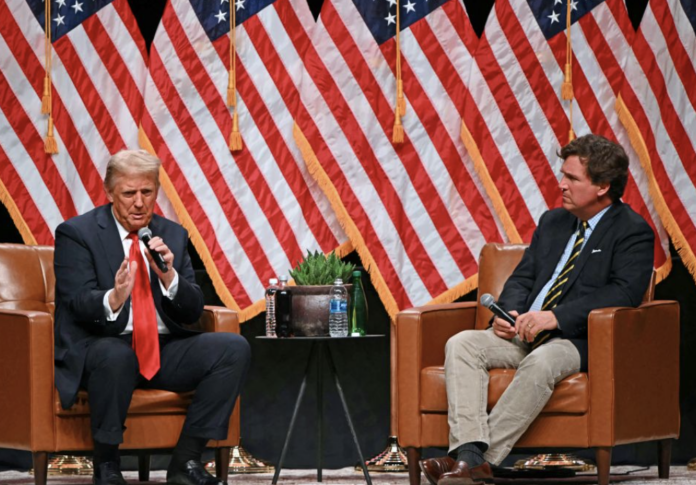
In a political twist that’s becoming increasingly familiar, former allies of Donald Trump are now some of his loudest critics. Leading that charge is Tucker Carlson, once a prominent voice in Trump’s corner, now positioning himself in direct opposition to the president on key issues—especially foreign policy.
Carlson, who previously appeared at Trump rallies and championed his agenda, has spent the past year carving out a dramatically different lane. His criticism has intensified as Trump doubles down on a more aggressive Middle East strategy, particularly regarding Iran. While Trump has pushed for strong action to prevent Tehran from acquiring nuclear weapons, Carlson has questioned both the urgency and the justification for such moves.
The split is not subtle. Carlson has gone as far as calling Trump’s actions “evil,” while amplifying voices that challenge long-standing Western narratives on global conflict, alliances, and history.
But the backlash to Carlson’s shift has been just as fierce.
Critics argue that his platform has increasingly featured controversial figures, including individuals accused of promoting extremist ideologies and historical revisionism. At the center of the latest firestorm is Carlson’s recent commentary on Winston Churchill—a figure widely regarded as a cornerstone of Allied resistance during World War II.
In a podcast segment, Carlson suggested Churchill imprisoned political opponents unjustly during the war, referencing Oswald Mosley as an example. Historians and commentators quickly pushed back, noting that Mosley was not a legitimate opposition leader but the head of the British Union of Fascists, a group aligned with Nazi Germany. Mosley’s internment, they argue, came amid wartime fears of internal sabotage and collaboration with Hitler’s regime.
The dispute over history has quickly evolved into something larger: a battle over the direction of the American right.
Adding to the tension, former National Counterterrorism Center Director Joe Kent resigned this week, reportedly over disagreements tied to Iran policy. Within hours, he appeared on Carlson’s platform, raising further questions about coordination and alignment among Trump’s critics on the right. The FBI has since opened a leak investigation tied to Kent’s departure, though details remain limited.
Despite the noise, Trump appears to retain firm support from his base. His allies argue that his foreign policy approach reflects strength and clarity at a time of global instability, while critics warn that internal division could weaken the broader movement.
What’s clear is that this is no longer a simple disagreement over policy. It’s a high-stakes ideological struggle playing out in real time—one that could shape not just Trump’s future, but the identity of the conservative movement itself.