
Have you ever wondered what mysteries lie beneath the ground, waiting to be discovered? Well, buckle up because we’ve got an exciting story from Crete, Greece, that’s creating quite a buzz in the archaeological world!
A massive, 4,000-year-old stone building has been unearthed on a hilltop in Crete, and it’s causing quite a stir. Not just among archaeologists but also because it might interfere with a major airport project on this popular tourist island. Let’s dig into the details!
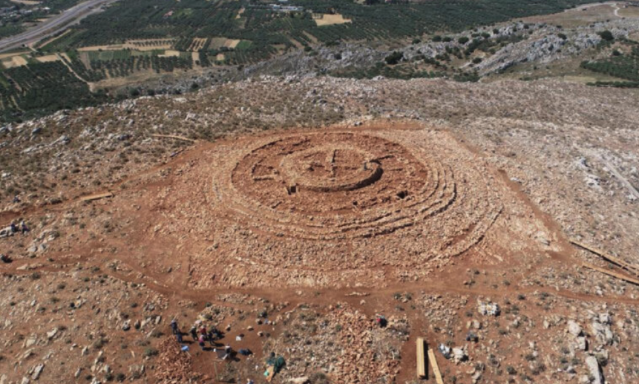
The Greek Culture Ministry announced on Tuesday that this structure is a “unique and extremely interesting find” from the Minoan civilization. If you’re not familiar, the Minoans were known for their lavish palaces, vibrant art, and mysterious writing systems. This newly discovered building, which resembles a giant car wheel from above, measures a staggering 1,800 square meters (19,000 square feet). Archaeologists came across it during an excavation planned for a radar station that would serve the new airport near the town of Kastelli.
The new airport, which is set to open in 2027, is designed to replace Greece’s second-biggest airport in Heraklion and is expected to handle up to 18 million travelers annually. But the discovery of this ancient structure might change those plans.
MORE ON big, round, 4,000-year-old circular labyrinthine stone building with no known Minoan parallels discovered on a Cretan hilltop puzzling archaeologists & threatening to disrupt a major airport project 🫨😱🤷🏻♂️🐂🐃https://t.co/YP4Y3Hqi7z https://t.co/oJm0YLZ0py pic.twitter.com/zgrI9sVyYC
— Sarah (@Sarah404BC) June 12, 2024
So, what was this mysterious building used for? That’s the big question. Archaeologists are still excavating, and they haven’t found anything quite like it in Minoan culture. For now, they speculate it might have been used for rituals or religious ceremonies. The building, surrounded by eight stepped stone walls up to 1.7 meters (5.6 feet) high, is divided into smaller, interconnected spaces. It’s believed it may have had a shallow conical roof.
Interestingly, the ministry noted that it doesn’t seem to have been a dwelling. Inside, they found a large quantity of animal bones, suggesting it might have been used for ritual feasts involving food, wine, and possibly offerings. The statement highlighted that its size, architectural design, and careful construction suggest it required significant labor, specialized knowledge, and strong central administration. Clearly, this was a communal building of great importance.
Culture Minister Lina Mendoni, herself an archaeologist, has vowed to preserve this remarkable find. She assured that the radar station would be relocated to protect the ancient structure. Mendoni emphasized the importance of balancing cultural heritage with modern development, saying, “We all understand the value and importance of cultural heritage … as well as the growth potential” of the new airport project.
The building dates back to between 2000 and 1700 B.C., around the same time as the construction of Crete’s first palaces, such as Knossos and Phaistos. Some of its features resemble early Minoan beehive tombs with stepped conical roofs, which are common in other parts of Greece.
Greece’s rich cultural heritage often leads to conflicts during construction projects. At the end of the last century, an entire hilltop fortified settlement from the 3rd millennium B.C. was uncovered and then destroyed during the construction of Athens International Airport. So far, at least 35 archaeological sites have been discovered during work on the new Kastelli airport and its road connections.