
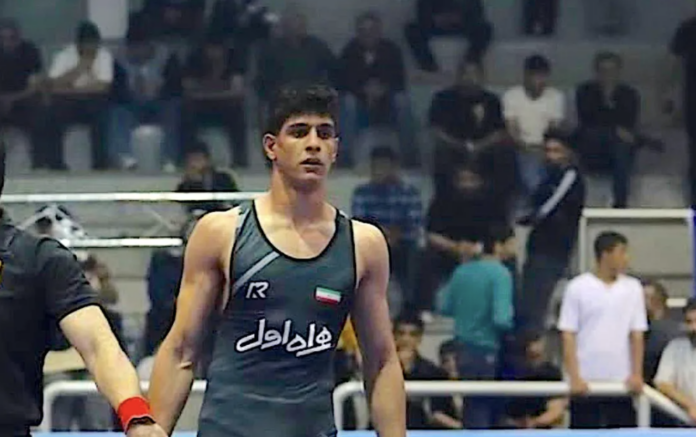
According to reports from Iran International, Mohammadi was executed by public hanging alongside two other men, Mehdi Ghasemiand and Saeed Davoudi. The regime accused all three of killing two police officers during nationwide protests earlier this year, a claim widely disputed by activists and dissidents who argue the charges were part of a broader crackdown on unrest.
The execution has triggered a wave of reaction from prominent Olympic athletes, many of whom are speaking out forcefully against what they describe as a brutal and unjust act.
Olympic gold medal wrestler Brandon Slay, who has deep ties to Iran through international competition, expressed heartbreak over the killing. He pointed to the humanity of the Iranian people while condemning what he described as a terror-driven regime, offering prayers for Mohammadi’s family and those suffering under oppression.
Swimmer Tyler Clary, a gold medalist from the 2012 London Olympics, called the execution a stark example of authoritarian rule. He described the process leading to Mohammadi’s death as a sham and framed the incident as a reminder of the stakes involved in confronting regimes like Iran’s on the global stage.
Three-time Olympic bobsled champion Kaillie Humphries delivered one of the most pointed responses, calling the execution “beyond abhorrent” and highlighting the stark contrast between freedoms enjoyed by athletes in the United States and the dangers faced by those in Iran. She emphasized that Mohammadi’s status as a young athlete made the act even more disturbing.
19-year-old champion wrestler Saleh Mohammadi executed by Iran in a public hanging.
Mohammadi, Mehdi Ghasemi, and Saeed Davoudi were executed as part of Iran’s brutal crackdown on protests.
According to human rights groups, Mohammadi was tortured to confess “to the capital… pic.twitter.com/L1ycjiw2P1
— Collin Rugg (@CollinRugg) March 19, 2026
Modern pentathlete Eli Bremer echoed that outrage, describing the killing as evidence of deep moral decay within Iran’s leadership. He warned that a regime willing to execute a teenage athlete poses a broader threat beyond its borders.
Five-time Olympian Katie Uhlaender focused on what she called a failure of the international community to act despite clear warning signs. She urged stronger leadership and accountability, arguing that athlete safety must become a non-negotiable global standard.
Other voices added even sharper criticism. Israeli Olympian AJ Edelman framed Mohammadi’s death as symbolic of resistance against a regime he harshly condemned, while Iranian wrestling champion Sardar Pashaei warned that the execution reflects a wider system of control, intimidation, and violence within Iranian sports.
Pashaei claimed that Iranian athletics are no longer governed independently but are instead controlled by powerful state forces, placing athletes at risk both at home and abroad. He also cautioned that more lives could be in danger, urging immediate international action.
The execution comes at a time of heightened tensions inside Iran, where protests have been met with aggressive crackdowns. For many observers, Mohammadi’s death is not just an isolated tragedy but part of a broader pattern that continues to draw global condemnation.