
Welcome back to Forgotten Fact Checks. This week’s edition turns the spotlight on the Washington Post, where mass layoffs have exposed a deeper problem that goes well beyond budget spreadsheets: a newsroom still mentally parked in 2016, unable or unwilling to reckon with why readers walked away.
After the Washington Post cut roughly 30 percent of its journalistic workforce last week, reaction inside legacy media circles was swift and predictable. Reporters and former editors framed the layoffs not as a market correction, but as a moral failure by owner Jeff Bezos, accusing him of undervaluing journalism’s supposed civic mission.
Former executive editor Marty Baron set the tone, calling the cuts “one of the darkest days in the history of one of the world’s greatest news organizations.” He warned that the Post’s “ambitions will be sharply diminished” and blamed Bezos for “ill-conceived decisions,” including declining to have the editorial board endorse Kamala Harris for president in 2024.
That decision did, in fact, trigger outrage. Roughly 250,000 subscribers reportedly canceled their subscriptions following the shift, along with the editorial page’s broader move toward individual liberty and free-market themes. But the idea that this moment alone pushed the paper into crisis is revisionist history.
The Washington Post was already bleeding money. In 2023, it lost $77 million. In 2024, losses climbed to $100 million. Subscriber growth stalled years earlier, with digital subscriptions peaking at three million during the 2020 election before sliding to 2.5 million by 2023. Last year, print circulation fell below 100,000 for the first time in more than half a century.
Still, instead of using the layoffs as a moment for introspection or innovation, many at the Post responded by doubling down on the same ideological posture that helped drive readers away.
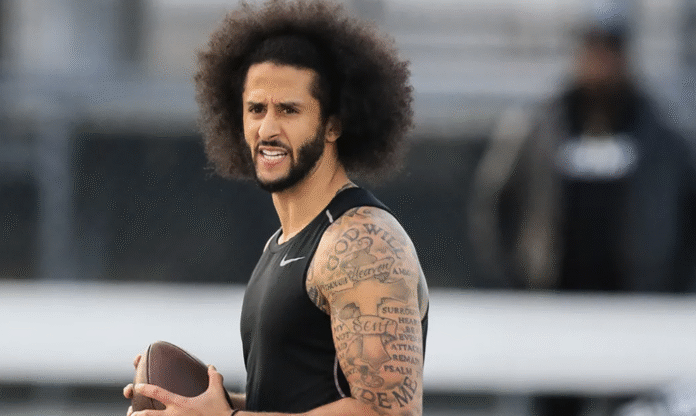
Case in point: as part of the cuts, the Post eliminated its entire sports desk. One of the last stories published under that banner came from national sports reporter Adam Kilgore, who transitioned to the features desk but chose to use his farewell to spotlight a familiar political figure from nearly a decade ago: Colin Kaepernick.
In a week dominated by major sports events, including the start of the Winter Olympics in Milan and Super Bowl LX, the Post ran a full-length piece titled, “What do we make of Colin Kaepernick now?” Kilgore went so far as to label the former San Francisco 49ers quarterback, who has not played in the NFL in nine years, “the most relevant figure to Super Bowl LX.”
It’s not too late for the Patriots and the Seahawks to be on the right side of history and start Colin Kaepernick in the Super Bowl. pic.twitter.com/Upvp5MApQ1
— Lou Perez (@LouPerez) February 8, 2026
The reasoning was exactly what readers have come to expect. The Super Bowl, Kilgore argued, was being played in Kaepernick’s former stadium, during a cultural moment that supposedly mirrored the controversies surrounding his national anthem protests. Therefore, his absence from the conversation was framed as a moral failing of the league and the public.
“Colin Kaepernick might as well be a ghost,” Kilgore wrote.
Readers clicking into the article were greeted with similarly politicized recommendations from the sports section, including headlines tying Olympic coverage to JD Vance’s motorcade and questioning the meaning of representing America itself.
This is the disconnect critics of the layoffs keep ignoring. The reporting does not lean right. It does not even aim for neutrality. It reflects a worldview that assumes progressive cultural commentary is the default lens through which all news, including sports, must be filtered.
National Review’s Noah Rothman summarized the attitude perfectly, citing commentary from Slate’s Alex Kirshner and MSNBC’s Chris Hayes arguing there is no serious market for news aimed at conservatives, and that asking reporters to appeal beyond a left-of-center audience is “an impossible job.”
But Bezos is not obligated to subsidize perpetual losses, especially when competitors are thriving. The New York Times and Wall Street Journal both posted record profits while the Post sank deeper into the red.
New leadership changes are already underway. Publisher and CEO Will Lewis announced he would step down after just two years. Executive Editor Matt Murray told staff the paper will refocus on U.S. politics, national security, and lifestyle coverage tied to reader interest.
Whether that shift signals a genuine course correction or simply a rebranding of the same old habits remains to be seen. What is clear is this: blaming layoffs on a lack of ideological purity does nothing to explain why readers left in the first place.