
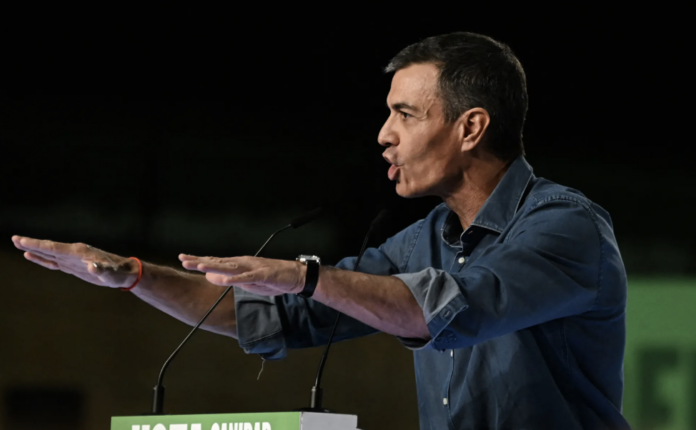
Spanish Prime Minister Pedro Sánchez and his Socialist party suffered a major setback Sunday after regional election results in Andalucía showed voters continuing to shift away from the country’s traditional left-wing strongholds.
For decades, Andalucía served as a reliable base for the Spanish Socialist Workers’ Party, known as the PSOE. The party governed the southern autonomous community continuously from 1982 until 2018, helping cement its reputation as one of Spain’s most dependable centers of left-wing political support.
That dominance now appears firmly broken.
According to Spain’s public broadcaster RTVE, the PSOE recorded its worst-ever result in the region, winning just 22.7 percent of the vote. The outcome is expected to leave the party with only 28 seats in the 109-member Andalusian parliament. The result marks another decline after the party secured 30 seats in 2022, 33 seats in 2018, and 47 seats in 2015.
No One Voted For This! Socialist Spain Starts Process to Provide Amnesty to Illegalshttps://t.co/HD6cyL5LUH
— Breitbart London (@BreitbartLondon) April 15, 2026
The Socialist campaign was led by María Jesús Montero, Spain’s former finance minister and a close ally of Sánchez. Both figures have faced mounting political pressure in recent months amid corruption allegations that have weighed heavily on the national government.
Following the election results, Montero acknowledged the defeat and conceded that voters had sent a clear message.
“We take note,” she said after the vote.
“The citizens place us in the opposition, and from there we are going to exercise,” she added.
The election also unfolded against the backdrop of several major controversies facing Sánchez’s government. Public frustration has intensified following January’s deadly high-speed train crash near Adamuz in Córdoba province. Although the investigation remains ongoing, many Spaniards have directed criticism toward the national government, which oversees the country’s rail infrastructure and transportation system.
At the same time, the vote became an early political test for Sánchez after his recent clash with the Trump administration over military cooperation. Tensions escalated after Sánchez reportedly refused to allow U.S. forces to use military bases in Spain during Operation Epic Fury in Iran. The dispute fueled speculation about potential economic retaliation from Washington and raised broader questions about Spain’s relationship with NATO allies.
Spain Suffers Second Fatal Train Crash in a Weekhttps://t.co/bJ9BKkMlXU
— Breitbart London (@BreitbartLondon) January 21, 2026
While the Socialists experienced the most dramatic losses, the center-right People’s Party, or PP, also saw its support slip slightly. The party’s vote share fell from 43.1 percent in 2022 to 41.6 percent in Sunday’s election. That decline is expected to reduce the PP’s representation from 58 seats to 53 seats, leaving it just short of the 55-seat majority needed to govern alone.
As a result, the PP will likely need support from the populist VOX party to maintain control of the regional government.
VOX was the only major national party to improve its standing in the election. The anti-mass migration party increased its vote share from 13.5 percent in 2022 to 13.8 percent this year, reinforcing its growing influence in Spanish politics.
Juanma Bonilla, leader of the Andalusian People’s Party and regional president since 2019, indicated that cooperation with VOX could be possible moving forward. Political observers believe any agreement in Andalucía could serve as a model for future alliances at the national level ahead of Spain’s next general election.
VOX’s continued rise is also expected to strengthen opposition to Sánchez’s controversial migrant amnesty proposal, which could grant legal status to hundreds of thousands of migrants in the coming months.