
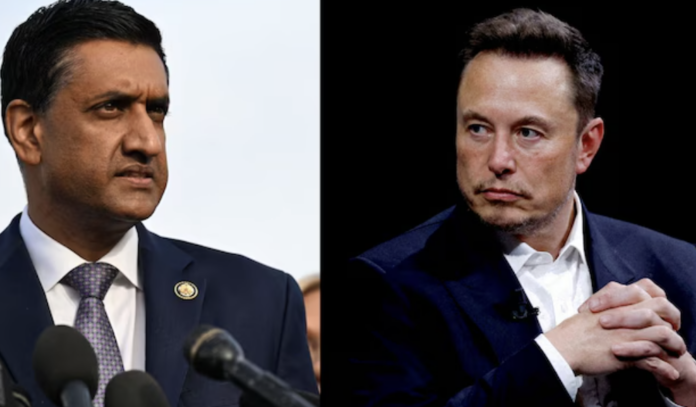
Elon Musk, owner of the social media platform X, appears to have reached his limit with Democratic Rep. Ro Khanna of California.
According to the New York Post, Khanna recently appeared on the left-leaning “I’ve Had It” podcast with host Jennifer Welch, where he accused Musk of causing severe harm through his work with President Donald Trump’s Department of Government Efficiency, known as DOGE, in early 2025.
Khanna said Musk “needs to answer” for what he described as “4.5 million children around the world who he possibly sentenced to death by dismantling USAID.”
Musk responded Tuesday on X with a blunt legal threat.
“Time to sue this liar,” he wrote.
But Musk did not stop there. The billionaire, who recently became the world’s first trillionaire, also attacked Khanna over congressional stock trading and gave him a nickname meant to stick.
“The standard applied by DOGE was very simple and easy: Provide contact information for the recipients of aid, so that we can confirm it is not fraudulent. The reality is that money was being sent to corrupt politicians under the guise of aid! Liars and stock insider traders like Ro the Robber should be in prison!!” Musk wrote.
Musk appeared to lean into the “Ro the Robber” nickname in later posts, making clear that his frustration with Khanna went beyond one podcast comment.
The dispute centers on USAID, the foreign aid agency that became one of DOGE’s major targets during Musk’s time helping lead Trump’s government-cutting effort.
Musk and his supporters have argued that DOGE exposed serious waste and corruption inside the agency. Critics, including Khanna, have argued that the cuts damaged humanitarian programs and placed vulnerable people at risk.
Musk eventually broke with the Trump administration in the spring and summer of 2025 over what he saw as a betrayal of DOGE’s mission in the president’s “Big Beautiful Bill.” Since then, Musk and Trump have appeared to quietly repair at least some of the damage between them.
Still, the fight over USAID has remained a major point of contention.
Democrats reacted sharply when DOGE began targeting the agency in February 2025. Around that same time, Robert F. Kennedy Jr., who had been confirmed as Health and Human Services secretary, described USAID as a “sinister” agency while speaking in Trump’s presence.
“It has been captured by the military-industrial complex,” Kennedy said, according to NBC News. “It has become a sinister propagator of totalitarianism across — and war — across the globe. And very few people understand how sinister this agency really is.”
Supporters of DOGE have argued that USAID was presented to the public as a lifeline for hungry children while, in reality, too much money flowed through unaccountable channels.
That is the core of Musk’s argument. He said DOGE was not asking for anything complicated. It simply wanted contact information for aid recipients so officials could verify that taxpayer money was going where it was supposed to go.
Musk’s defenders have also pointed to broader concerns about government fraud. In December, YouTuber Nick Shirley reported on alleged fraud in Minnesota’s Somali immigrant community. That revelation helped fuel Trump’s decision to name Vice President J.D. Vance to lead a national fraud task force.
For critics of Washington spending, the issue is not limited to USAID. They argue that the federal government routinely uses sympathetic causes to justify programs that end up enriching bureaucrats, contractors, and politically connected groups.
That is why Musk’s response to Khanna struck a nerve. Whether or not Musk follows through with a lawsuit, he made clear that he is not willing to let the USAID accusation pass unanswered.