
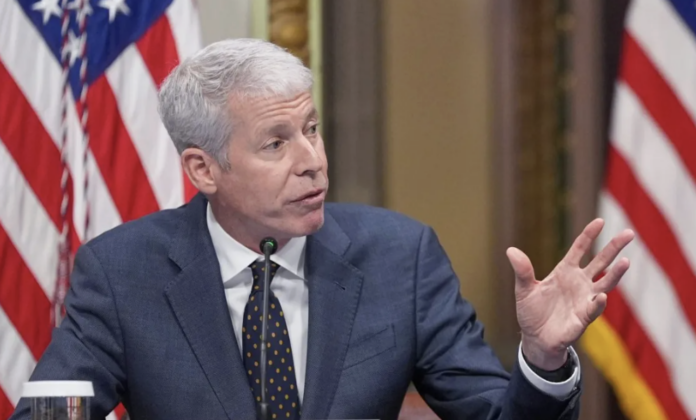
Energy Secretary Chris Wright warned lawmakers Wednesday that Iran is dangerously close to obtaining weapons-grade enriched uranium, raising fresh concerns about Tehran’s nuclear ambitions as the Trump administration pushes for a deal to dismantle the regime’s nuclear program.
Appearing before the Senate Armed Services Committee, Wright said Iran’s current stockpile of highly enriched uranium has brought the country within weeks of crossing a major nuclear threshold.
“They are a small number of weeks away to enrich that to weapons-grade uranium,” Wright told senators. “There’s still a weaponization process that happens after that, but they’re quite close.”
The comments come as President Trump ramps up pressure on Tehran to surrender its enriched uranium stockpiles as part of ongoing negotiations aimed at permanently halting Iran’s nuclear development efforts.
Special envoy Steve Witkoff recently claimed Iran possesses enough uranium enriched to 60% purity to produce material for roughly 11 nuclear weapons if further refined to 90%, the level typically considered weapons-grade.
Nuclear experts have long warned that once a country reaches 60% enrichment, the technical leap to 90% becomes significantly smaller and faster than the earlier stages of enrichment.
Iran is believed to currently possess about 1,000 pounds of uranium enriched to 60%, according to US officials and international monitoring estimates.
Sen. Richard Blumenthal (D-Conn.) agreed with Wright during the hearing that Iran could likely convert that stockpile into weapons-grade material within weeks if it chose to do so.
Iran also reportedly maintains an additional 11 tons of uranium enriched to lower levels, including 20% purity.
“They have some 20% enriched uranium, and that’s several more weeks behind the 60%,” Wright explained. “With unenriched uranium, it’s a long process to get it to weapons-grade. But when you’re at 60%, you are — although the numbers don’t sound that way — way closer to 90% of the way there for the enrichment necessary for weapons-grade uranium.”
“It’s very concerning,” he added.
Blumenthal suggested that any long-term solution would likely require the removal not only of the 60% enriched stockpile, but also the larger reserve of lower-enriched uranium to prevent Iran from rebuilding its program later.
“I think that’s the wise strategy,” Wright replied. “Ultimately, the goal is to prevent future enrichment of uranium as well. Yes, to have a safe world, we need to end their nuclear program.”
Trump has repeatedly vowed that the US will obtain Iran’s enriched uranium “one way or another,” though administration officials have been somewhat vague publicly about whether they are demanding only the highly enriched material or the country’s entire nuclear stockpile.
According to reports, US negotiators are seeking the complete relinquishment of all enriched nuclear material. Iran has so far resisted those demands.
Russian President Vladimir Putin has reportedly offered to assist in removing deeply buried uranium from Iranian nuclear sites if Tehran agrees to hand it over.
Trump claimed earlier this week that Iranian negotiators had privately indicated a willingness to surrender what he called the “nuclear dust” before later reversing course.
“They said, ‘You’re going to have to take it,’” Trump told reporters Monday. “The site was so obliterated that there’s only one or two countries in the world that could get it.”
The US and Israel previously targeted Iranian nuclear facilities during military operations known as Operation Midnight Hammer and Operation Epic Fury. American officials say the sites are now being closely monitored by satellite surveillance, with the administration warning that further military action remains on the table if Iran resumes nuclear activity.
Trump reportedly considered deploying US ground forces earlier this year to physically retrieve the enriched uranium from underground facilities, though such an operation was viewed as extremely risky due to radiation exposure concerns and the logistical challenge of operating deep inside Iranian territory.
For now, the administration continues to pursue diplomacy. Talks between Washington and Tehran are currently being mediated through Pakistan, though Trump recently dismissed Iran’s latest proposal as “unacceptable.”
Vice President JD Vance, who has been directly involved in negotiations, said Wednesday that discussions have shown signs of progress but cautioned that Trump’s core demand remains unchanged.
“The president has set us off on the diplomatic pathway for now,” Vance said. “The red line is very simple. He needs to feel confident that we’ve put a number of protections in place such that Iran will never have a nuclear weapon.”