
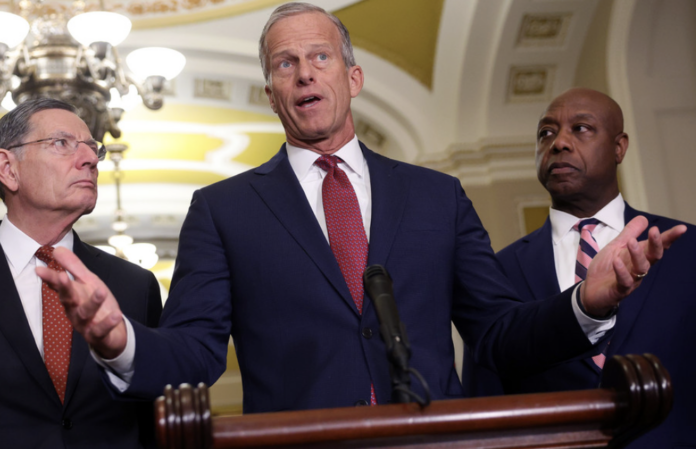
The Department of Homeland Security still hasn’t been fully funded, even with President Donald Trump’s June 1 deadline now just days away. What was supposed to be a major Republican legislative priority has instead turned into another example of how difficult it can be for the GOP to unify around spending legislation, even when the party controls Congress and the White House.
Senate Majority Leader John Thune (R-SD) officially halted attempts to move the bill forward on Thursday after Senate Republicans failed to reach an agreement on several provisions within the package. Rather than continue negotiations into the weekend, lawmakers left Washington early for recess, effectively ensuring the Senate would miss Trump’s timeline for passing additional funding for Immigration and Customs Enforcement (ICE) and Customs and Border Protection (CBP).
The collapse frustrated many conservatives, particularly because Republican leadership had repeatedly promised the funding package would move through the reconciliation process, allowing it to pass with only GOP votes. Instead, disagreements inside the conference, combined with procedural setbacks from the Senate Parliamentarian, stalled the effort.
Conservative commentators and activists quickly turned their criticism toward Thune. Some accused Senate Republicans of wasting time trying to negotiate with Democrats despite little chance of bipartisan support. Others argued that leadership failed to prepare for procedural challenges early enough.
BREAKING: Senate GOP and WH cannot agree on bill to fund ICE, CBP, security amidst sharp divide over Trump’s ballroom and “weaponization fund”.
Senators tell me the bill “still needs work”.
— Lisa Desjardins (@LisaDNews) May 21, 2026
The debate over DHS funding has also become wrapped up in broader Republican political fights. Some of the tension reportedly stems from President Trump’s continued push against establishment Republicans during the primary season. Trump recently endorsed Texas Attorney General Ken Paxton over Sen. John Cornyn (R-TX), while Sen. Bill Cassidy (R-LA) has faced criticism from parts of the GOP base after failing to consolidate support heading into the midterms.
Another sticking point involves provisions included in the legislation itself. Beyond border enforcement funding, the package also contains money for several Trump administration priorities, including a new anti-weaponization fund tied to claims that the Biden Justice Department unfairly targeted conservatives. The administration recently moved forward with plans for a settlement fund reportedly worth more than $1.7 billion intended to compensate individuals allegedly harmed by prior DOJ actions.
The current standoff follows months of competing proposals in Congress. Earlier this spring, the Senate advanced a narrower DHS funding bill that excluded certain ICE and CBP operations, while the House passed a separate continuing resolution designed to fully fund the department for 60 days. Both proposals aimed to ensure civilian support employees for ICE and CBP continued receiving paychecks during the funding dispute.
🚨 IT’S OFFICIAL: Senate Republicans will now MISS President Trump’s June 1 deadline to pass ICE and CBP funding, as John Thune decides to RECESS the Senate until NEXT MONTH
Thune is a FAILURE.
President Trump is NOT going to be happy about this. Time to remove Thune! pic.twitter.com/EhX6CrAZOO
— Nick Sortor (@nicksortor) May 21, 2026
President Trump also stepped in directly by issuing an executive order restoring pay for Transportation Security Administration workers. That move temporarily eased pressure on Republicans by removing one of the Democrats’ strongest political talking points during the standoff.
Meanwhile, Sen. Lindsey Graham (R-SC) attempted to reset the conversation in April by introducing legislation that would fully fund DHS through 2029, effectively covering the remainder of Trump’s second term. House Republicans later advanced a procedural vote tied to the broader funding effort, though the Senate still failed to finalize the package before recess.
At this point, the issue is about more than just another delayed budget resolution. The DHS package has become a test of whether congressional Republicans can deliver on key Trump administration priorities while managing internal divisions. With lawmakers now out until June, the next phase of negotiations will likely determine not only the future of DHS funding, but also how effectively GOP leadership can navigate the growing pressure from both the White House and the party’s conservative base.