
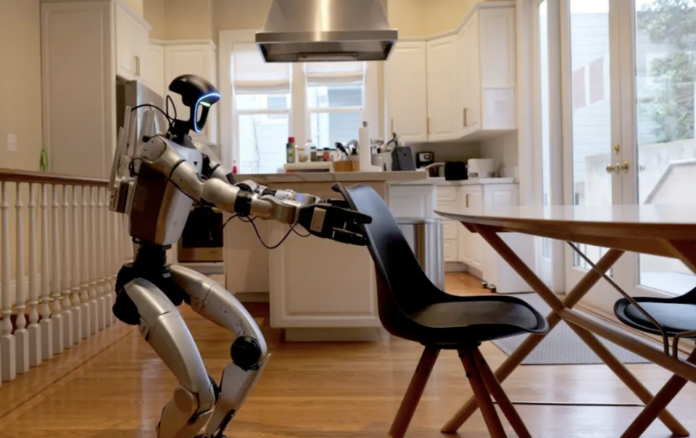
Within the next decade, humanoid robots could become common in American homes, workplaces, hospitals, factories, and government facilities. They will not be passive machines tucked away in a corner. They will see, hear, move, learn, map their surroundings, and interact with people in the most private and sensitive spaces of daily life.
That future raises a question the United States cannot afford to treat as theoretical: will these robots be built by American companies operating under American rules, or will they be made in China?
Winning the robotics race is not just a matter of commercial pride. It is a national security and economic necessity. The administration and Congress have both begun to recognize the stakes. The challenge now is to move quickly, with a strategy that is serious, practical, and capable of earning broad bipartisan support.
Robotics is increasingly where artificial intelligence enters the physical world. The old model of large, stationary, single-purpose machines is giving way to general-purpose humanoids that can learn new tasks and operate in human environments. The potential is enormous.
A humanoid robot could help care for an aging parent, prepare meals, or assist a surgeon during a difficult procedure. These machines could enter burning buildings, clean up nuclear waste, inspect deep-sea pipelines, and take on dangerous or repetitive manufacturing jobs that too often come at the expense of workers’ health and safety. Goldman Sachs has projected that the humanoid robot market could reach $38 billion by 2035. The countries and companies that lead this field will gain more than profits. They will gain influence, leverage, and a long-term strategic advantage.
That is why China’s progress should alarm policymakers.
This past Lunar New Year, videos of Chinese humanoid robots dancing and performing martial arts in coordinated routines spread widely online. The display was impressive, but it was also meant to send a message. China’s Ministry of Industry and Information Technology has identified humanoid robots as a strategic emerging industry, and Beijing has poured enormous state resources into building dominance in the field. Some market reports indicate that as many as 90% of humanoid robots are built in China.
This is not merely a commercial challenge for the United States. It is a national security problem developing in plain sight.
Think about what it would mean for Chinese-manufactured robots to become embedded across American homes, hospitals, factories, schools, and public agencies. These machines would see rooms, hear conversations, map buildings, record routines, and interact with sensitive systems. They would connect to the cloud and receive software updates from manufacturers that could change what they do, what they collect, or how they behave.
Americans already understand that modern technology carries surveillance risks. But humanoid robots are different. A smartphone may know where you are. A humanoid robot may know the layout of your home, the habits of your family, the vulnerabilities of your workplace, and the details of your private life.
China’s civil-military fusion doctrine makes the risk even more serious. A robot designed to fold laundry, carry supplies, or assist in a warehouse could also be adapted for logistics, reconnaissance, or other military uses. A large commercial network of Chinese-built humanoid robots would not be just a consumer product category. It would be a latent tool of state power.
The United States has faced strategic technology races before, and it has won them. But those victories did not happen by accident. They came through national strategy, public and private investment, and policy frameworks that treated critical technologies as more than ordinary consumer goods. Robotics requires the same level of urgency.
Commercial drones offer a warning. A decade ago, the United States allowed China to dominate the market with little industrial policy response. Today, Chinese manufacturers control a major share of the global drone sector, and American businesses, police departments, and even parts of the military became dependent on Chinese hardware before Washington fully recognized the risk. Recent efforts to restrict foreign-made drones and address security concerns are important, but they are reactive. We are trying to unwind a dependency that should never have been allowed to develop.
We cannot repeat that mistake with humanoid robots.
The Trump administration has shown that it understands the stakes in artificial intelligence and cybersecurity, using federal strategy to align government resources with national priorities. Its work on a national robotics strategy should be ambitious and comprehensive. A serious strategy should set clear global leadership goals, expand federal procurement and research support, strengthen the domestic supply chain for critical robotics components, establish American leadership in robotics standards, and create tough data security rules to prevent hostile actors from gaining access to sensitive environments.
Congress should move at the same time. Senators Chuck Schumer and Tom Cotton have introduced the American Security Robotics Act, which would largely prevent the federal government from buying or operating humanoid robots made by Chinese firms. That kind of bipartisan action is rare, and it reflects the seriousness of the threat.
The bill is a useful first step, but lawmakers should go further with care. The United States needs guardrails that protect the country from fully integrated Chinese robotic systems. At the same time, policymakers must recognize that some key robotics components, including motors and magnets, are not yet manufactured competitively at home. America should reduce its dependence on Chinese components and build that capacity domestically, but blunt bans that ignore supply-chain realities could slow the growth of the very American robotics industry we need to strengthen.
The window to act is open, but it will not stay open indefinitely. China’s Lunar New Year robot display was a preview of a much larger competition. The country that leads in humanoid robotics will shape the physical world in much the same way that the country that led in semiconductors shaped the digital one.