
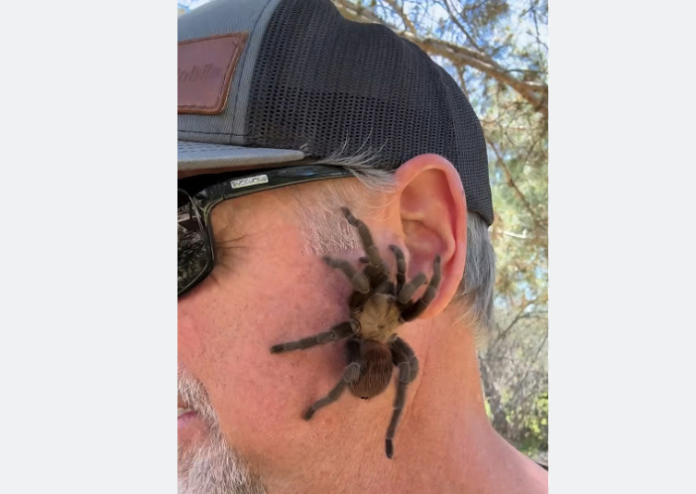
Hello everyone, if you have a fear of spiders, especially the big, hairy kind, you might want to reconsider your travel plans to the southern United States, particularly around southern Colorado.
Why, you ask? Well, because the region is about to be hit by an invasion of tarantulas—yes, you heard that right—swarms of Texas brown tarantulas are on the move.
These fist-sized, eight-legged wanderers, known scientifically as Aphonopelma hentzi, have a yearly tradition of emerging from their hideouts as the temperatures begin to drop. And according to experts, 2024 is shaping up to be no different. So, if the thought of thousands of tarantulas creeping across the ground sends shivers down your spine, it might be best to steer clear.
These spiders are a regular sight across Texas and New Mexico, with some making their homes in Arizona’s Sonoran desert. But it’s in places like Colorado where they really make their presence known. Now, before you start envisioning a scene straight out of a horror movie, let’s be clear—these tarantulas aren’t out to get you. In fact, despite their fearsome reputation, they’re actually pretty shy creatures. During the day, they stay low to the ground, hiding in sheltered spots or abandoned burrows, and only come out at night to hunt for a tasty insect or maybe even a small rodent.
So why do they suddenly decide to come out in droves, scurrying across the landscape? Well, it’s all about love—or at least, the spider version of it. From late August through October, male tarantulas are driven by the irresistible urge to find a mate. They bravely venture out into the open, covering as much as a kilometer (just over half a mile) in search of the perfect female. It’s a high-stakes game of tarantula Tinder, with the males hoping to impress a lady with the right moves—though in the tarantula world, things can get a bit more intense, considering the female might just decide to eat her suitor if the vibe isn’t right.
For the males, it’s a busy season, with some managing to mate with over 100 females before the frenzy is over. Once the mating is done, fertilized egg sacs can contain a thousand or more tiny spiders, all of which will hatch after about 45 to 60 days under the watchful eye—or should I say eyes—of the mother.
Between tarantulas swarming CO & locusts raining on Vegas the invertebrates are taking over & who is prepared for that?? https://t.co/2ufHGbM6YE
— Maccabirdee 🎗️🟦🐧 (@TWreninator) August 9, 2019
So, if you’re thinking of visiting the southwest, you might want to time your trip carefully. Unless, of course, you’re one of those brave souls who finds the idea of a tarantula swarm more fascinating than frightening. As for the biologists in the area, they’re already on the case, trying to get a count of these eight-legged wanderers—a spider census, if you will.
As for me, I think I’ll pass on the spider swarm.