
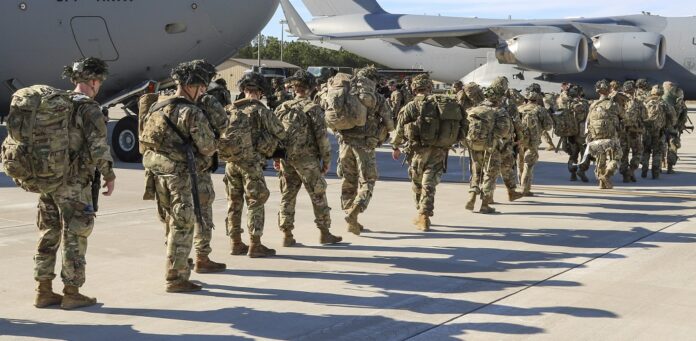
In response to a surge in violence between Israel and Hezbollah, the U.S. has announced the deployment of additional troops to the Middle East, heightening concerns about the possibility of a broader regional conflict. The Pentagon confirmed this move on Monday, emphasizing the growing instability in the area and the need for enhanced U.S. presence to protect both American and allied interests. While the specifics regarding the number of troops or their exact mission were not disclosed.
In the last few hours, the Israeli Air Force has continued with Operation Northern Arrows, as several Hezbollah Launchers and other Military Infrastructure were Targeted and Destroyed across Southern Lebanon. pic.twitter.com/90z99eLGwe
— OSINTdefender (@sentdefender) September 24, 2024
Currently, the U.S. maintains around 40,000 military personnel in the region, but the latest developments could lead to an even stronger presence. As part of this heightened readiness, the aircraft carrier “USS Harry S. Truma” along with two destroyers and a cruiser, has left Norfolk, Virginia, heading toward the Mediterranean on a pre-planned mission. Notably, this opens up the possibility of both the *Truman* and the *USS Abraham Lincoln*, stationed in the Gulf of Oman, being positioned close by to respond swiftly should the conflict further intensify.
Multiple Deaths and over a Dozen Injuries, following the Israeli Airstrike within the last hour on the Dahieh Suburb of Beirut. pic.twitter.com/baN3MNvn3H
— OSINTdefender (@sentdefender) September 24, 2024
Maj. Gen. Pat Ryder, the Pentagon’s press secretary, acknowledged the additional troop movement, citing it as a precautionary measure driven by increased regional tensions. However, he refrained from providing detailed information, pointing to operational security concerns.
Meanwhile, Israeli forces have conducted major airstrikes in Lebanon, targeting Hezbollah positions and causing significant casualties. With further military operations on the horizon, Israeli Prime Minister Benjamin Netanyahu issued a stark warning to Lebanese civilians, urging them to evacuate in anticipation of an expanded air campaign. In light of these developments, the U.S. State Department has strongly advised American citizens to leave Lebanon while commercial flights are still available, stressing the unpredictable and volatile nature of the conflict.
Shocking scenes in Lebanon as the IDF bombs the house of a local fireworks enthusiast. Just look at his collection of Catherine wheels, Roman candles and bottle rockets going off.
Well, either that or Hezbollah are hiding arms caches in civilian houses. Hard to say. pic.twitter.com/sl0obPvwBE
— Andrew Fox (@Mr_Andrew_Fox) September 23, 2024
The question of whether U.S. forces could play a role in evacuating American citizens remains unanswered. While Ryder refused to comment on potential evacuation plans, the situation continues to be monitored closely. Defense Secretary Lloyd Austin has been in direct communication with his Israeli counterpart, Yoav Gallant, advocating for de-escalation and a ceasefire. Yet, as Ryder pointed out, the risk of a wider regional war is becoming more palpable, though it has not yet fully materialized.
The U.S. military’s presence in the Middle East remains multifaceted, with a focus on defending Israel and safeguarding U.S. personnel and infrastructure. A broad array of Navy warships and Air Force assets are already in position, strategically placed across the region from the Mediterranean Sea to the Gulf of Oman, ready to respond should the conflict spread further.