
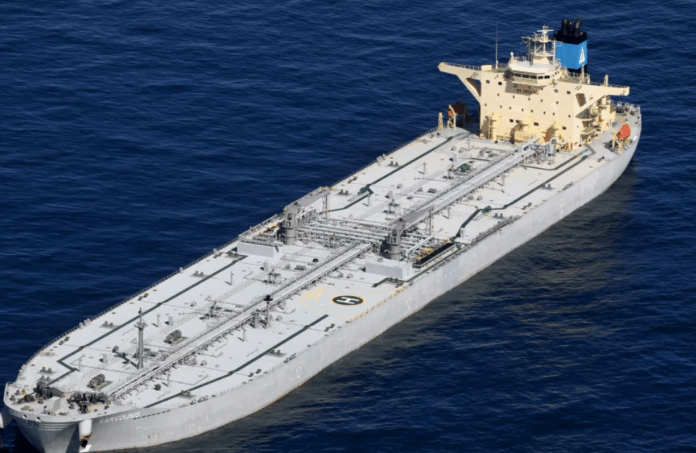
U.S. Attorney General Pam Bondi released video footage Wednesday of American forces boarding and seizing a crude oil tanker off the coast of Venezuela. The operation, according to Bondi, was part of an ongoing effort to enforce U.S. sanctions against oil exports from Venezuela and Iran.
The video, which quickly spread across social media, shows U.S. personnel approaching the vessel by sea and air before boarding it. The Department of War, FBI, Homeland Security Investigations, and the U.S. Coast Guard all worked together in the operation. Bondi said the seizure was carried out safely and without conflict.
Bondi stated that the tanker had been sanctioned for years due to its alleged role in helping to move oil for foreign terrorist organizations. She said the ship was part of what she called an “illicit oil shipping network” used by countries like Iran and Venezuela to avoid U.S. restrictions on their oil sales.
“This seizure, completed off the coast of Venezuela, was conducted safely and securely—and our investigation alongside the Department of Homeland Security to prevent the transport of sanctioned oil continues,” Bondi said in her public statement.
Today, the Federal Bureau of Investigation, Homeland Security Investigations, and the United States Coast Guard, with support from the Department of War, executed a seizure warrant for a crude oil tanker used to transport sanctioned oil from Venezuela and Iran. For multiple… pic.twitter.com/dNr0oAGl5x
— Attorney General Pamela Bondi (@AGPamBondi) December 10, 2025
President Donald Trump confirmed the raid during a press briefing on Wednesday, saying, “We seized it for very good reasons.” When asked what the U.S. planned to do with the oil on board, the president said, “We’ll keep it, I guess,” but did not give additional details.
This is the latest move in a string of actions by the Trump administration aimed at pressuring Venezuelan leader Nicolás Maduro. The U.S. government considers Maduro’s regime illegitimate and continues to push for his removal. The White House has placed a $50 million bounty on Maduro and warned of possible military strikes targeting drug cartel operations and other infrastructure inside Venezuela.
In recent years, the U.S. military has sunk over 20 vessels off the Venezuelan coast that were believed to be carrying illegal drugs, including fentanyl and cocaine. Officials say the region remains a hotspot for drug trafficking, and U.S. forces have maintained a visible presence in the area to intercept ships suspected of smuggling narcotics.
The oil tanker seized this week reportedly belongs to a network of ships connected to Venezuela’s state-owned oil company, PDVSA. Because of U.S. sanctions, Venezuela has relied on sales to countries like Iran and China, often at steep discounts. These discounted sales help the Maduro regime bring in revenue despite being largely cut off from the global financial system.
The decision to take the ship directly targets Venezuela’s primary economic resource—its oil. Sanctions have made it increasingly difficult for Maduro’s government to sell oil abroad, which has led to shortages and inflation inside the country.
The U.S. still has business interests in Venezuela, particularly through energy giant Chevron. Earlier this year, the U.S. Treasury Department gave Chevron a waiver from certain sanctions, allowing the company to drill for oil in partnership with PDVSA. Under that deal, Chevron gives a portion of the oil it produces to the Venezuelan government as payment for access.
The latest action shows that the Trump administration remains committed to taking a tough stance on both Venezuela and Iran, especially when it comes to oil sales that U.S. officials say support dangerous regimes and terrorist groups.
Officials have not yet released the final destination of the seized oil, or whether the U.S. plans to use, sell, or store it. Investigations into the tanker’s previous routes and business partners are ongoing.