
The Seattle Times is facing criticism after longtime sports columnist Matt Calkins resigned following the newspaper’s decision not to publish one of his columns.
Calkins, who spent 11 years at the paper, announced his departure on Substack. According to his account, the disagreement centered on a column he wrote about the debate over transgender athletes participating in women’s sports. Calkins said the piece was reviewed by several editors before he was eventually told it would not run.
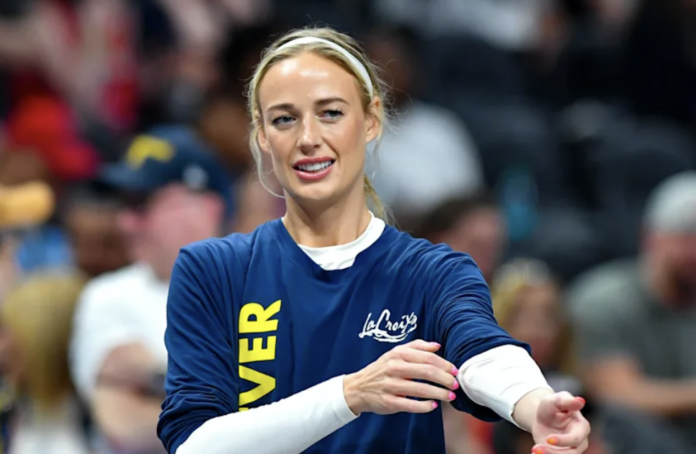
The column focused partly on WNBA player Sophie Cunningham and female athletes who have publicly raised concerns about maintaining sex-based divisions in women’s sports. Calkins argued that expressing those concerns should not automatically be treated as hateful or bigoted.
“Some people saw bigotry. I saw bravery,” he wrote.
Calkins described meeting several female athletes outside Seattle’s Climate Pledge Arena on July 28, when Cunningham’s Indiana Fever played the Seattle Storm. The athletes were participating in a rally supporting Cunningham, and one carried a sign thanking her for “speaking up for girls.”
The broader argument in Calkins’ unpublished column centered on the physical differences between male and female athletes. He pointed to measurable performance gaps in areas such as sprinting, jumping, weightlifting and golf driving distance. His position was that women’s sports were created as a separate category precisely because those physical differences matter in competition.
Longtime Seattle Times sports columnist Matt Calkins is walking away after 11 years, saying the paper refused to publish his column giving a voice to female athletes who oppose transgender athletes competing in women’s sports.
“I couldn’t do my job as a columnist because I feel… pic.twitter.com/kAKq618qQH
— Fox News (@FoxNews) August 20, 2026
At the same time, Calkins wrote sympathetically about people who experience gender dysphoria, describing the difficulty of feeling as though they were born in the wrong body. His argument, however, was that compassion for transgender people and concern about competitive fairness in women’s sports do not have to be mutually exclusive.
The controversy became larger when Calkins explained why he believed the Seattle Times rejected the column.
According to him, an editor said the article would not be published because Calkins had failed to tell the newspaper in advance that he intended to write about the subject. Calkins said he found that explanation difficult to accept because the column had already moved through several levels of editorial review.
“If that were the case, the piece would have been killed on the spot, not passed through the hands of multiple editors over several days,” he wrote.
Calkins also said this was not the first time one of his columns had been rejected when he challenged views that were widely accepted within the newsroom.
He recalled writing a column questioning whether members of the U.S. Women’s National Soccer Team had been victims of discrimination in their equal-pay lawsuit. Another dealt with cancel culture in sports. A third, written after George Floyd’s death, highlighted comments from championship basketball coach Mike Bethea, who urged people not to stereotype police officers.
In Calkins’ view, the common thread was that each column challenged a prevailing narrative and risked provoking a strong reaction.
After 11 years as a sports columnist at the Seattle Times, I have decided to resign. It was entirely my choice, and it was not an easy one. The impetus was the Times declining to run a column I wrote from the perspective of two female student athletes who were opposed to…
— Matt Calkins (@Matt_Calkins) August 20, 2026
The Seattle Times did not immediately provide a detailed public response to his allegations. A representative told HuffPost that the newspaper would not discuss personnel matters.
That leaves the central dispute unresolved. The Seattle Times may have had internal editorial reasons for rejecting the column, but Calkins clearly believed the decision reflected something larger: a reluctance to publish arguments that could generate political or cultural backlash.
That concern reaches beyond one newspaper or one columnist. Journalism depends on editors making judgment calls every day, and not every submitted column is entitled to publication. But newspapers also build credibility by allowing readers to encounter arguments that challenge prevailing assumptions.
When a veteran columnist concludes that certain subjects can no longer be discussed openly at his own newspaper, it raises a legitimate question about the boundaries of acceptable debate inside modern newsrooms.
Calkins ultimately decided that boundary had become too restrictive. Rather than continue under those conditions, he walked away from a job he had held for more than a decade.
Whatever one thinks about the transgender-athlete debate itself, his resignation has turned an unpublished sports column into a much larger argument about editorial independence, newsroom culture and the willingness of journalists to publish unpopular views.