
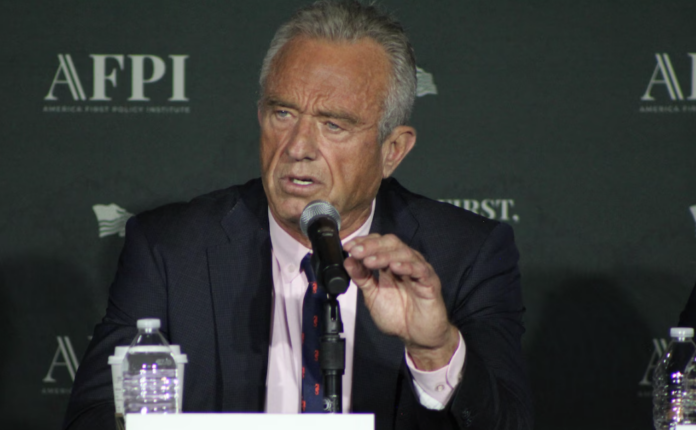
Health and Human Services Secretary Robert F. Kennedy Jr. said Tuesday that the U.S. obesity rate fell last year for the first time in 50 years, calling the decline a sign that the country may be beginning to reverse one of its most expensive and widespread health problems.
Kennedy made the remarks during an event hosted by the America First Policy Institute in Charlotte, Michigan.
“Since President Trump came into office, obesity rates in this country have dropped by 2.5 percent,” Kennedy said. “That’s the first drop in 50 years. And that drop alone will have significant impacts on health care costs in this country, because obesity drives about 80 percent of chronic disease.”
The financial stakes are significant. According to the most recent data from the Treasury Department, health care spending accounts for about 35 percent of federal expenditures. In fiscal year 2024, the federal government spent $1.9 trillion on health care programs, making health care the largest category of federal spending.
Kennedy also pointed to the sharp rise in obesity among children over the past several decades.
“Thirty-five percent of American adults are obese,” he said. “When my uncle, John F. Kennedy, was president, 3 percent of children were obese. Now, it’s 20 percent.”
A Gallup survey released last October reported a similar downward trend. The firm said the U.S. adult obesity rate reached a record high of 39.9 percent in 2022 before declining to 37 percent in 2025. Gallup described the drop as statistically meaningful and estimated that it represented 7.6 million fewer obese adults compared with three years earlier.
The polling firm also noted that the growing use of weight loss drugs, including Ozempic, has likely contributed to the decline.
Kennedy, however, focused much of his criticism on ultraprocessed foods and federal dietary guidance.
“Why did Americans suddenly get obese?” Kennedy asked. “It’s not because they suddenly became indolent or lazy or hungry. It’s because they were being mass poisoned by ultraprocessed foods.”
He argued that past food guidelines pushed Americans away from protein and whole foods and toward products that damaged metabolic health.
“Seventy percent of the calories, when we came in, are ultra-processed foods, and it’s poisonous,” Kennedy said. “It destroys your metabolic system. It makes you obese.”
Kennedy also connected ultraprocessed foods to rising rates of diabetes and prediabetes.
“When I was a kid, a typical pediatrician would see one or two cases of Type 2 diabetes over a 40- or 50-year career,” he said. “Today, 38 percent of American teens are diabetic or pre-diabetic.”
Gallup reported that diabetes reached an all-time high of 13.8 percent of the U.S. population in 2025.
A study published last year by the National Institutes of Health said ultraprocessed foods make up more than half of total dietary energy consumption in the United States. The study noted that these foods are often high in sodium, sugar and unhealthy fats, and may contribute to glucose dysregulation and insulin resistance, both of which can increase the risk of prediabetes and Type 2 diabetes.
The NIH described ultraprocessed foods as products that undergo multiple industrial processes before they are purchased or eaten. Common examples include soft drinks, packaged snacks, margarine and sausages. These foods are often calorie-dense while being low in protein, vitamins and minerals.
Insulin resistance occurs when the body’s muscle, fat and liver cells do not properly respond to insulin, making it harder to process blood sugar. Over time, excess blood sugar can contribute to obesity, prediabetes and diabetes, according to the Cleveland Clinic.
Along with medical treatment when needed, common recommendations include eating more whole foods, reducing added sugar and increasing physical activity. The Cleveland Clinic says movement and exercise can make the body more sensitive to insulin and help build muscle that absorbs blood glucose.
Kennedy’s Make America Healthy Again initiative has focused on reducing ultraprocessed foods in programs where the federal government plays a role, including school lunches and SNAP benefits.
He summed up his advice simply: “Eat real food.”