
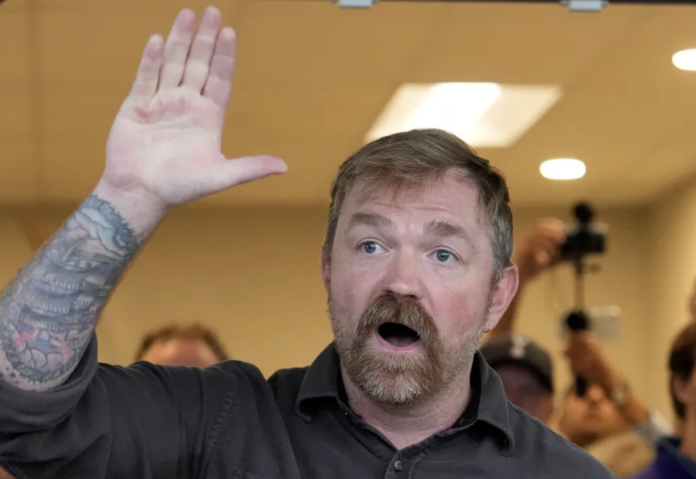
Anyone who watched all 11 minutes of Graham Platner’s campaign withdrawal video deserves some credit. That takes either an unusually strong commitment to civic life or a remarkable tolerance for political self-pity. In 2026, those qualities may overlap more than anyone would like to admit.
The basic message was predictable. Platner denied the most serious allegation against him, rejected the idea that ending his campaign amounted to an admission of guilt and blamed powerful forces for making it impossible for his movement to continue with him as its candidate.
“We believe that for the movement to continue, it can’t be me,” Platner said. “And for that reason, we are suspending campaign operations.”
This isn’t pheasant hunting.
Without shotguns, it’s bird watching.
Nice phony photo op put on by the Harris campaign and @pheasants4ever.
pic.twitter.com/6K7LCT1Glm— Tim Murtaugh (@TimMurtaugh) October 12, 2024
He insisted that the decision was not based on the allegations.
“This is incredibly difficult because I know that some will think it’s an admission of guilt, and it most certainly is not,” he said. “We’re not doing it because of the allegations. We’re doing it because of the structures that are being taken away from us by those in power.”
That explanation may have satisfied his remaining supporters, but Pennsylvania Democratic Sen. John Fetterman offered a much harsher assessment shortly after the video appeared.
Democrat John Fetterman to Graham Platner:
“You will only be remembered as the accused rapist that got pushed out of your election…the guy that roughs up your ex-girlfriend…go back under the rock where you came from.” pic.twitter.com/QI8lUbmawB
— RNC Research (@RNCResearch) July 9, 2026
“Bro, you will only be remembered as the accused rapist that got pushed out of your election,” Fetterman said during an appearance on Fox News.
Fetterman had criticized Platner well before the latest allegation became public. He had previously raised questions about Platner’s online history, including an account reportedly connected to the username “P-Hustle” and a profile photograph showing Platner shirtless with a towel around his waist.
After those details emerged, Fetterman challenged Platner to demonstrate that the people involved in his online exchanges were adults.
“You can just prove that all these people that you’re dropping those d*** pics and saying those things to were over 18,” Fetterman said, “and I will wear a suit every day in the Senate.”
My name might be on the ballot right now, but that ballot line belongs to the people of Maine. pic.twitter.com/RKVyLU76tm
— Graham Platner for Senate (@grahamformaine) July 9, 2026
Platner apparently never provided the public response Fetterman demanded.
Following Platner’s withdrawal announcement, Fetterman returned to the same theme. He used the “P-Hustle” nickname while accusing Platner of mistreating women and attempting to escape responsibility for his past.
“That’s your legacy, bro,” Fetterman said. “So go back under that rock that you came from.”
Beneath the insults, Fetterman’s broader point was difficult to miss. Platner’s campaign did not collapse because of one awkward interview, one old photograph or one isolated controversy. It fell apart because damaging claims and revelations continued to accumulate while supporters repeatedly argued that each new problem could be explained away.
The pattern is familiar in politics. A candidate emerges as an outsider, energizes voters who feel ignored and builds a following around the idea that established institutions are afraid of him. When troubling information surfaces, supporters dismiss it as irrelevant, exaggerated or politically motivated. When more information appears, the same defense is repeated.
Eventually, however, the weight becomes too great.
There will be plenty of analysis about how Platner’s campaign unraveled. Some will blame weak vetting. Others will criticize party leaders, activists or reporters. There will also be another round of discussion about the Democratic Party’s recurring attempts to present carefully manufactured candidates as authentic representatives of the working class.
Graham Platner talked about Israel in his fundraising emails more than any other Democrat running this cycle pic.twitter.com/VPFCGTKNAp
— Milan Singh (@milansingh03) July 8, 2026
That problem is hardly new. National Democrats have spent decades trying to prove that elite politicians are ordinary people by placing them in hunting clothes, pickup trucks, diners or other supposedly relatable settings. The details change, but the political theater remains largely the same.
Platner’s case was more serious than a failed attempt at image management. His supporters were asked to overlook one controversy after another because he inspired the right faction of the party and directed its anger toward the right targets.
Each time another problem emerged, defenders argued that the larger movement mattered more than the candidate’s personal history. That strategy worked until it did not.
Platner may prefer to frame his departure as a sacrifice made to preserve a political movement. His critics will remember it differently. They will see a candidate with a deeply troubling public record who was defended long after the warning signs became impossible to ignore.