
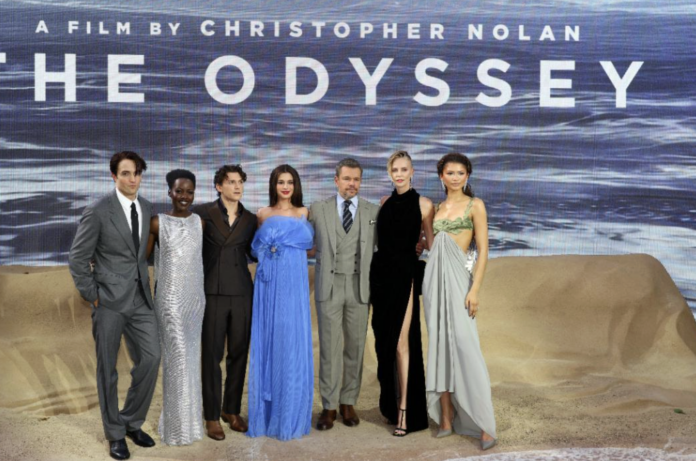
For a while, Christopher Nolan seemed like one of the rare Hollywood figures who could come close. After years of major critical and box office success, Nolan built the kind of reputation most filmmakers would envy. He became the director who could make large-scale, ambitious movies that still felt serious, controlled, and unmistakably his.
Part of Nolan’s appeal is that his filmography reaches a wide audience without feeling completely scattered. Comic book fans have his darker, more grounded Batman trilogy. Science fiction fans have films like “Inception” and “Interstellar.” Viewers drawn to history and war dramas have “Dunkirk” and “Oppenheimer.”
His newest project, an adaptation of Homer’s Greek epic “The Odyssey,” would seem to fit most naturally into that last category.
But that is where the trouble has started.
Some Greek viewers, writers, and filmmakers have raised concerns about the casting of Nolan’s film, arguing that a story rooted so deeply in Greek culture appears to include very few Greek actors. The cast is large, famous, and varied, but according to reports, only one Greek actor appears in the film, and that role is described as a nameless background part.
The casting choice drawing the most attention is Lupita Nyong’o as Helen of Troy. Nyong’o is an acclaimed actress, but some critics of the decision have argued that casting a black actress in one of the most famous roles from Greek mythology reflects a broader problem: Greek people being pushed to the side in adaptations of their own cultural stories.
According to The Telegraph, Greek and Greek Cypriot media platforms sent open letters to Nolan’s team and to Hollywood expressing those concerns. The letters reportedly argued that Greek people “did not vanish” and are “still here” as “a living people whose story has never stopped being written.”
One letter made clear that the objection was not meant as a rejection of diversity or creative reinterpretation.
“We are not asking for exclusion or limitation,” the letter said. “We are not arguing against diversity, nor against reinterpretation. Greek culture itself has always been shaped by exchange, migration, and encounter across centuries.”
The letter continued: “What we are asking is something simpler and more human. That, when Greek stories are retold on a global stage, Greek people are not rendered invisible within them.”
One Greek filmmaker also raised the issue of diversity, equity, and inclusion requirements in Hollywood, saying it would be “despicable” if Nolan’s casting choices were influenced by an attempt to satisfy Academy Award DEI standards.
The criticism has not been limited to Greek commentators. According to OutKick, the trailer for “The Odyssey” has been hit with a large number of dislikes. YouTube no longer publicly displays dislike totals, but third-party tools still attempt to estimate them.
OutKick reported that outside estimators showed more than 542,000 dislikes on the final trailer, compared with roughly 64,000 likes. The outlet described that as a ratio of nearly 90 percent negative to positive.
Beyond Nyong’o’s casting as Helen of Troy, several other choices have also received mixed reactions. Nolan cast Elliot Page, a transgender actor, as Sinon, described here as a soldier and a key cousin of Odysseus. Indian actor Himesh Patel is set to play Eurylochus, one of Odysseus’ companions.
Still, the most divisive casting choice may be rapper Travis Scott, who is reportedly playing a Homeric bard.
For Nolan, who has spent much of his career enjoying unusual goodwill from both audiences and critics, “The Odyssey” may be shaping up as one of his first major tests in the age of instant backlash.