
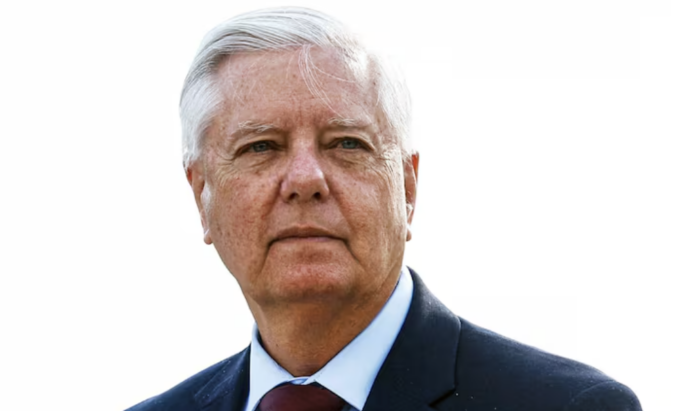
Sen. Lindsey Graham was alone at his Washington home Saturday evening when he began experiencing chest pain. Instead of immediately calling emergency services, he reached out to a member of his staff.
Sen. Tommy Tuberville of Alabama described Graham’s final call while speaking with reporters Monday. According to Tuberville, Graham called his scheduler, who was eating at a restaurant with one of Tuberville’s aides at the time.
The staffer asked Graham whether he had called 911. “No, I called you,” Graham reportedly answered.
The scheduler then contacted emergency services and headed toward Graham’s home. Dispatchers received a call concerning his Washington address at approximately 8:30 p.m. By the time the staffer arrived, emergency personnel had forced their way inside and were attempting to save him.
Graham, who had turned 71 two days earlier, died Saturday, July 11. Preliminary findings from the Washington, D.C., medical examiner identified the cause as an aortic dissection, a serious condition in which the inner wall of the body’s main artery tears. Additional toxicology and microscopic testing remained pending.
The South Carolina Republican had recently returned from Ukraine and had spoken with President Donald Trump earlier that evening. Graham had remained deeply involved in foreign policy and Senate business until the final days of his life.
Sen. Tommy Tuberville (R-AL) says his former staffer called 911 on behalf of Sen. Lindsey Graham after Graham said he was experiencing chest pains.
“By the time she got there, 911 had knocked the door down,” Tuberville said. “They were working on him.” pic.twitter.com/1qZqn5obDh
— CBS News (@CBSNews) July 13, 2026
Tuberville suggested that Graham’s relentless work habits had taken a toll on him.
“Lindsey basically worked himself to death,” Tuberville said.
He noted that Graham did not have a spouse or children and often used breaks in the Senate schedule to travel abroad or work on diplomatic and national-security issues.
“Most of us have families,” Tuberville said. “He didn’t have any family, and if we had a couple of days off, he went to that airport. He went somewhere to try to work out something for our country.”
Tuberville rejected claims that Graham’s death involved anything other than natural causes.
“No, there’s no conspiracy here,” he said.
Despite that assessment, Graham’s sudden death quickly produced speculation online, including unsupported claims that foreign governments or other political enemies might have been involved. Authorities have presented no evidence of foul play, and the preliminary medical findings point to a heart-related condition.
Missouri Sen. Josh Hawley said during a Fox News interview that investigators should still examine every possibility.
“I absolutely think there should be a full toxicology report, autopsy, the whole thing,” Hawley said.
Hawley pointed to Graham’s outspoken positions on Russia and Iran, saying the senator had made powerful enemies during his career. At the same time, Hawley acknowledged that he did not want to encourage baseless theories.
“I don’t want to be a conspiracy theorist,” he said. “And, you know, I hope that none of that is true.”
Hawley added that Graham’s constituents and the country deserved a complete account of what happened. A final determination will depend on the remaining medical tests.
On Monday, South Carolina Gov. Henry McMaster appointed Graham’s younger sister, Darline Graham Nordone, to temporarily fill the vacant Senate seat. Nordone is expected to serve through the end of Graham’s current term in January 2027.
Graham had represented South Carolina in the Senate since 2003 and was campaigning for another term at the time of his death. A Republican primary is scheduled for August 11, with the winner expected to face Democratic pediatrician Annie Andrews in the November general election.
For Graham’s colleagues, the circumstances of his death reinforced an image they had seen throughout his career: a senator who rarely stopped working, traveled constantly and remained focused on public affairs until his final hours.