
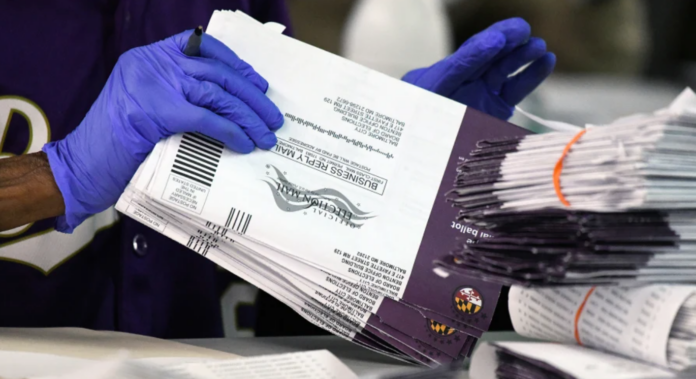
A federal district court in Massachusetts issued a preliminary injunction blocking the U.S. Postal Service’s new mail-in ballot rule from taking effect. The decision followed an earlier U.S. Supreme Court ruling that allowed the government to begin implementing President Donald Trump’s executive order while emphasizing that its decision did not mean that measures ultimately adopted to carry out the order would necessarily be lawful.
The Postal Service subsequently issued a final rule imposing new requirements on election ballot mail. The rule required action by state election officials and established requirements governing ballot-mail envelopes and related USPS procedures. The district court concluded that the plaintiffs were likely to succeed in showing that key provisions exceeded the Postal Service’s authority because Congress had not clearly authorized the agency to regulate the manner in which federal elections are conducted.
The Supreme Court later refused, in a 7-2 decision, to stay the district court’s injunction. The Court said the government was unlikely to succeed on the merits of its challenge to the preliminary injunction and that the equitable factors did not favor emergency relief. Justices Samuel Alito and Clarence Thomas dissented.
Constitutional Questions
The dispute involves Article I, Section 4 of the Constitution, known as the Elections Clause. It provides that states establish the times, places, and manner of congressional elections, while giving Congress authority to make or alter those regulations. The courts therefore considered whether Congress had authorized the Postal Service to impose the requirements contained in its new rule.
The district court concluded that the rule likely regulated the manner of holding federal elections and that the Postal Service lacked sufficient congressional authorization to exercise that power. The First Circuit agreed when it declined to stay the injunction, finding that general statutes authorizing USPS to regulate the collection, handling and delivery of mail were unlikely to provide the necessary authority for the election-specific requirements.
Justice Alito disagreed. In a dissent joined by Justice Thomas, he argued that the government had made the showing necessary for a stay and defended the Postal Service’s authority to regulate election ballot mail.
The Road Ahead
The litigation over the rule can continue while the preliminary injunction remains in effect. The district court found that allowing the requirements to take effect posed a risk that otherwise valid absentee or mail-in ballots would not be counted in the upcoming elections.
The Supreme Court’s refusal to stay the injunction means the Postal Service cannot implement the blocked rule while the injunction remains operative. The decision does not itself represent a final judgment resolving every issue in the underlying litigation, but the Court concluded that the government was unlikely to succeed in its challenge to the preliminary injunction.
Justice Brett Kavanaugh concurred in the denial of a stay but took a somewhat different approach. He wrote that there was “at least a fair prospect” that the final rule falls within the Postal Service’s statutory authority. Nevertheless, he concluded that the district court properly blocked the rule under the Administrative Procedure Act because state and local election officials did not have sufficient time to reasonably implement it before the elections.
The ultimate outcome will depend on further litigation over the scope of the Postal Service’s statutory authority and the legality of the rule’s requirements.