
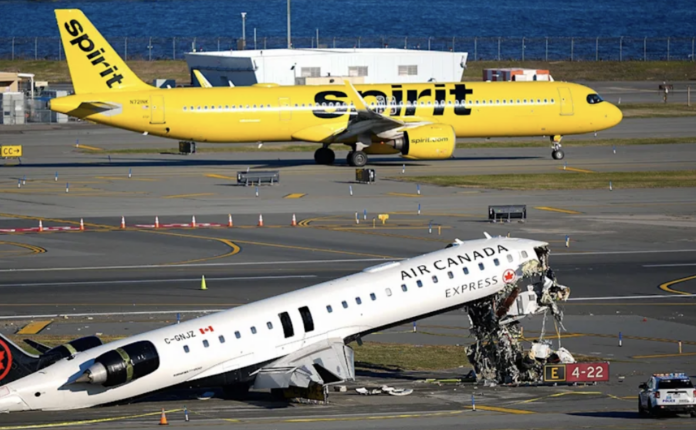
Transportation Secretary Sean Duffy said Sunday that the collapse of Spirit Airlines can be traced back, in part, to a decision made during the Biden administration to block a proposed merger with JetBlue. Speaking on ABC’s This Week, Duffy argued that the move—led by then-Transportation Secretary Pete Buttigieg and the Department of Justice—cut off what he sees as the airline’s last viable path to survival.
“The Joe Biden–Pete Buttigieg administration and DOJ tanked that deal,” Duffy said. “Immediately after that, they filed for bankruptcy.”
His comments came just hours after Spirit shut down operations early Saturday morning. By around 3 a.m., the airline had grounded all flights, closed its call centers and ticket counters, and begun what Duffy described as an “orderly liquidation process.” The sudden halt left travelers with little warning and even fewer options at airports.
According to Duffy, the situation created immediate confusion for passengers. “Spirit does not have airplanes in the air flying as of this morning,” he said. “If you have a flight scheduled with Spirit Airlines, don’t show up at the airport. There will be no one here to assist you.”
Federal officials and other airlines quickly stepped in to limit the fallout. The Department of Transportation coordinated with major carriers to accommodate stranded travelers, and several airlines introduced temporary pricing caps. Duffy said United, Delta, JetBlue, and Southwest agreed to keep one-way fares around $200 to prevent sharp price spikes during the disruption.
Beyond the immediate travel chaos, Duffy used the moment to revisit the earlier merger dispute. The Justice Department had challenged the JetBlue-Spirit deal on antitrust grounds, arguing it would reduce competition and ultimately lead to higher fares. At the time, administration officials framed the decision as a win for consumers.
Duffy sees it differently. “They bragged and said this was a victory for U.S. travelers who deserve lower prices and better choices,” he said. “This is not better for travelers. This is not better for pricing. This is not better for competition.”
Still, he acknowledged that Spirit’s problems didn’t begin with the blocked merger. The airline had been struggling financially for years, facing repeated bankruptcy concerns and difficulty sustaining its low-cost business model. “Spirit was in dire straits long before the war with Iran,” Duffy said. “Their model wasn’t working. They couldn’t get to fiscal health.”
He also made clear that a government bailout was never a likely option. “We oftentimes don’t have a half a billion dollars laying around in a spare account that we can put into a bailout of an airline,” he said.
For now, the focus remains on helping passengers adjust to the sudden disappearance of one of the country’s most recognizable budget carriers, even as the broader debate over regulation and competition in the airline industry continues.