
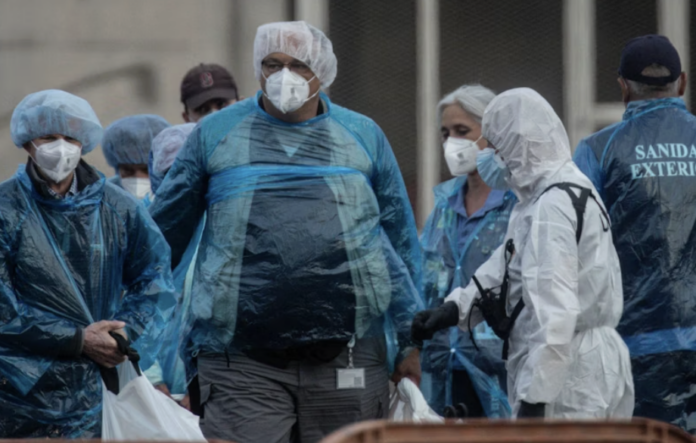
Eighteen American cruise passengers returned to the United States early Monday after spending weeks aboard the MV Hondius, the ship linked to a deadly hantavirus outbreak that has now sickened at least nine people and killed three.
The U.S. citizens disembarked in the Canary Islands on Sunday before boarding a government-arranged medical repatriation flight to Nebraska, according to federal health officials. The Dutch-flagged expedition cruise ship had departed southern Argentina on April 1 and traveled through remote islands in the South Atlantic when the outbreak emerged onboard.
Most of the returning passengers were taken to the University of Nebraska Medical Center in Omaha, home to the nation’s only federally funded quarantine unit. Officials said 16 Americans remain there under observation, including one passenger who tested mildly positive for hantavirus and is being treated in biocontainment.
Two other Americans, a couple who continued on to Atlanta, are also being monitored at Emory University’s specialized isolation facility. One of the two is reportedly showing symptoms.
Health officials say symptoms from exposure to the Andes strain of hantavirus can take up to 42 days to appear, which is why passengers will continue to be monitored for several more weeks.
“For the passengers getting off the ship, I’d say, ‘Welcome to Nebraska,’” said Dr. Ali Khan, dean of the College of Public Health at the University of Nebraska Medical Center. “You are coming to the premier facility in the United States, if not the world, to take care of you.”
The outbreak has sparked renewed concern about pandemic preparedness, even though experts emphasize that hantavirus is far less contagious than COVID-19. Scientists have studied hantaviruses for decades, and while the Andes strain can spread between people under certain conditions, transmission typically requires prolonged close contact with someone already showing symptoms.
“We do know that you can get small clusters of disease, but in 30 years we’ve never seen any large outbreaks,” Khan said. “So this is unlikely to become a pandemic.”
Still, the incident has raised questions about how quickly the U.S. government responded. Some public health experts argued federal agencies moved too slowly during the early days of the outbreak, especially as infected passengers remained aboard the ship.
Lawrence Gostin, a professor of global health law at Georgetown University, criticized what he described as a fragmented response.
“The CDC was missing in action for quite a long time,” Gostin said. “Better late than never — but it is very late.”
The Department of Health and Human Services strongly pushed back on that criticism. Spokesperson Emily Hilliard said the federal government has been coordinating a broad response involving the State Department, the CDC, and other agencies. Officials noted that CDC teams have been deployed to both the Canary Islands and Nebraska, while state health departments have been alerted about returning travelers.
Seven additional American passengers who left the cruise ship earlier are now being monitored in states including Texas, California, Georgia, and Virginia.
The situation has also revived memories of the Diamond Princess cruise ship outbreak early in the COVID-19 pandemic, when infected passengers remained quarantined onboard as the virus spread rapidly. Unlike COVID, however, health officials say the Andes virus does not spread easily through casual contact and is far less likely to trigger a widespread public health emergency.
Even so, experts say the episode exposed weaknesses in America’s ability to respond quickly to emerging infectious disease threats.
“If this was a highly transmissible virus,” Gostin warned, “you could imagine what chaos we would be facing now.”