
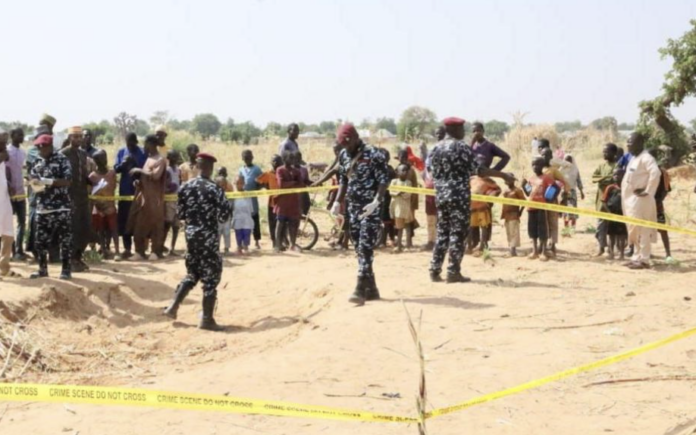
Nigeria and the United States have launched a new round of coordinated strikes against Islamic State-linked militants in northeast Nigeria, marking another major step in the growing military partnership between both countries. According to the US Africa Command (AFRICOM), the strikes were carried out on Sunday and targeted fighters linked to the Islamic State West Africa Province (ISWAP), one of the deadliest extremist groups operating in the region.
Nigeria’s military said the operation followed intelligence reports showing the movement and gathering of militant fighters in parts of the northeast. Multiple air strikes were then launched, killing more than 20 suspected ISWAP members. AFRICOM confirmed that intelligence had identified the targets as ISIS militants and said no American or Nigerian troops were injured during the mission.
The latest operation comes just days after Nigerian and US forces announced the killing of Abu-Bilal al-Minuki, a senior Islamic State figure described as the group’s second-in-command globally. Al-Minuki had been under US sanctions since 2023 and was considered one of the world’s most active terrorists. Nigerian officials said he played a key role in coordinating finances, propaganda, weapons production, explosives, and drone development for the extremist organization.
The Nigerian military described the latest strikes as a continuation of ongoing efforts to weaken ISIS-linked networks operating across the country’s troubled northeast. President Donald Trump and Nigerian President Bola Ahmed Tinubu both praised the mission, calling it a significant blow to the terrorist group’s operations in West Africa.
Nigeria has spent years battling insurgencies led by Boko Haram and ISWAP, especially in the northeastern part of the country. While Boko Haram gained international attention for mass kidnappings and attacks on civilians, ISWAP has emerged as a more organized and strategically dangerous offshoot aligned with the Islamic State group.
Security concerns in Nigeria go beyond jihadist violence. Large criminal gangs, commonly referred to as bandits, continue to carry out kidnappings, raids, and attacks on villages across several regions. Northern Nigeria in particular faces overlapping threats from extremist groups and heavily armed criminal networks.
The situation has become increasingly urgent as Islamist militancy expands across West Africa. A recent report by conflict monitoring organization ACLED found that Islamic State activity across Africa reached record levels during the first quarter of 2026, with West Africa now considered the world’s most active region for Islamist violence.
Despite recent military successes, concerns remain about possible retaliation following al-Minuki’s death. An intelligence source told AFP that ISWAP could launch revenge attacks against Nigerian military bases in response to the killing of such a high-profile leader.
The United States has increased its involvement in Nigeria’s security operations in recent months. Following joint Christmas Day airstrikes in Sokoto State targeting militants linked to the Islamic State in the Sahel, Washington expanded military support by deploying hundreds of personnel to help train and assist Nigerian forces.
Meanwhile, another security crisis unfolded in southwestern Nigeria last week when gunmen attacked three schools in Oyo State and kidnapped 46 people, most of them children. According to the Christian Association of Nigeria, the victims ranged from toddlers to teenagers. The attackers reportedly stormed Baptist Nursery and Primary School in Yawota along with two nearby schools in Esiele during what police described as a coordinated raid.
Authorities temporarily shut down surrounding schools after the attack to prevent further violence and allow security forces to stabilize the area. While school kidnappings have historically been more common in northern and central Nigeria, the incident highlights how insecurity is spreading into other parts of the country as criminal gangs continue to exploit weak security conditions.