
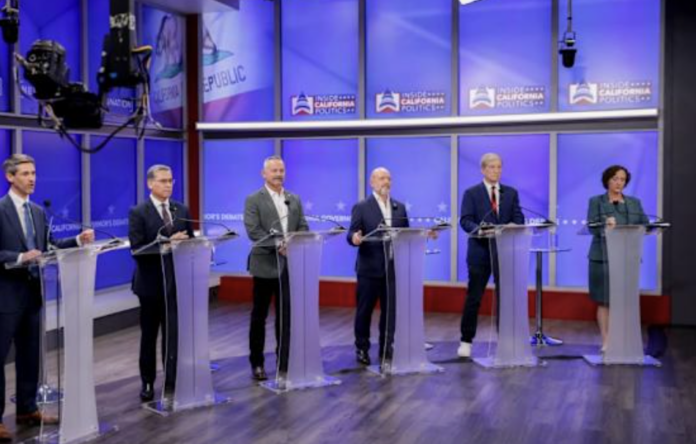
California’s crowded and still unsettled governor’s race finally made it to a debate stage Wednesday night, but anyone hoping for sharp exchanges or memorable moments didn’t get much. Instead, the six candidates delivered a fairly flat, sometimes meandering discussion that rarely broke out of familiar territory.
The debate, held in San Francisco, moved through the usual topics—cost of living, immigration, public safety, and President Trump—without much sense of urgency or direction. Candidates often seemed to talk past one another, which only underscored how unclear the race remains after former Democratic front-runner Eric Swalwell dropped out following serious allegations.
Xavier Becerra entered the night with some momentum in the polls, but he didn’t do much to build on it. His delivery came off as low-energy, and at times he stumbled. In one moment that stood out for the wrong reasons, he mistakenly said Trump had started a war with Iraq instead of Iran. Even so, some observers suggested that his steady, risk-averse approach might appeal to Democratic insiders looking for a safe option.
The clearest policy divide came over California’s gas tax. Becerra defended it as necessary for infrastructure funding, while Tom Steyer pointed the finger at oil companies and floated the idea of a mileage-based tax.
Katie Porter tried to balance affordability concerns with environmental priorities, and San Jose mayor Matt Mahan pushed for a temporary suspension paired with broader reforms.
The two Republicans took more direct positions. Riverside County Sheriff Chad Bianco argued for eliminating the gas tax altogether, saying the state could recover lost revenue by cutting waste. Steve Hilton echoed the frustration over high prices and said he would both reduce the tax and expand in-state oil production.
A brief but more pointed exchange emerged around immigration after discussion of a video showing a highway patrol officer testing a truck driver’s English proficiency. Bianco dismissed concerns about profiling, framing the issue strictly as law enforcement.
Porter pushed back, calling out what she described as harmful treatment of individuals. Hilton went further on the enforcement side, arguing that language barriers pose safety risks on the road. Steyer’s response, focused on legality, didn’t gain much traction.
There were a few attempts at sharper lines. Mahan took a swipe at Steyer over housing, referencing the billionaire’s past business ties. And when the conversation turned to homelessness, candidates split not just on solutions but tone. Democrats generally gave Governor Gavin Newsom middling but supportive grades, while Hilton bluntly called the state’s performance a failure.
The debate may have clarified the ideological lanes more than it showcased the candidates themselves. For voters, the choices are becoming easier to categorize, even if no single candidate managed to take control of the race on this stage.