
The ROW NYC Hotel, once one of Manhattan’s most controversial migrant shelter sites, has quietly reopened to tourists after nearly three years housing asylum seekers during New York City’s migrant crisis.
The massive 1,300-room hotel on Eighth Avenue near Times Square officially resumed operations last week, welcoming travelers back with renovated rooms, redesigned public spaces, and a polished new image that sharply contrasts with its recent past.
On Friday, fresh flowers decorated the entrance while tourists rolled suitcases through the busy lobby. The hotel is once again advertising itself as a modern Midtown destination, with rooms costing several hundred dollars per night.
Guests arriving during the reopening said the property appeared noticeably refreshed.
“When they said that they reopened today I was wondering what are the things they did to fix it because it looks good,” said Efrain Santiago, a visitor from Puerto Rico.
Santiago, who stayed on the hotel’s 24th floor, praised both the room conditions and customer service.
“The room is really clean and neat. I’m on the 24th floor with a great view. The employees and manager have been great to us,” he said.
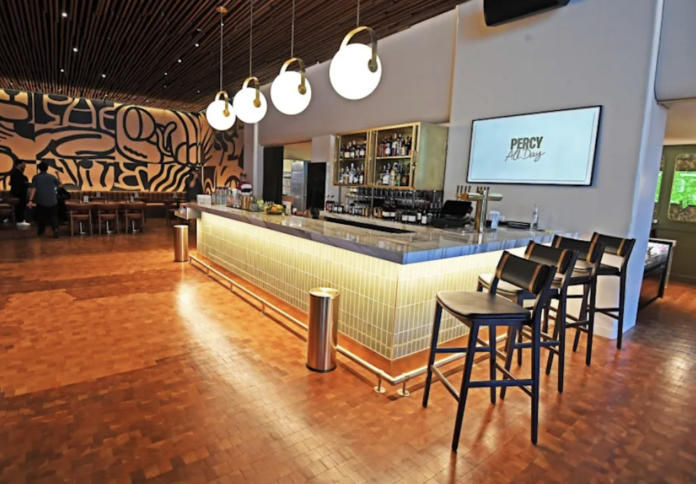
As part of the relaunch, the hotel introduced Percy All Day, a new 90-seat café and cocktail bar stretching across the lobby. The venue serves coffee and pastries during the day before transitioning into a cocktail and small plates spot at night. A retail corner known as “nyce things” now sells New York-themed merchandise, including hats, bags, and souvenirs.
Still, some visitors noticed that parts of the property remain unfinished.
Serena Villa, a tourist visiting from Austin, Texas, said she spotted exposed wiring near one of the elevators and found it concerning.
“I was a little concerned about the elevator because it looks like there were wires leaking out of the bottom,” Villa said. “There was a gap, and there are exposed wires coming out of it. I was like, that should not be there.”
Despite that issue, she said the hotel generally felt welcoming and well-maintained.
“Most of it’s pretty, the lobby looks really cozy,” Villa added, noting that staff members appeared especially attentive to guests.
Other visitors accidentally wandered into still-closed sections of the hotel that remain under renovation. Lauren Holland and Alyssa Davis, visiting from Kentucky, said they reached the second floor by mistake and found areas that looked heavily damaged and unfinished.
“It was just really dirty and pretty torn up,” Holland said. “The walls were white and had polka dots on them, like stickers stuck on the wall.”
Tony Machado, Senior Vice President and Head of Design at Highgate, the company operating the hotel, said the property is reopening gradually as renovations continue floor by floor. So far, about 300 rooms have been fully completed.
Machado said crews installed new carpets, furniture, mattresses, paint, lighting, artwork, and bathroom fixtures throughout the hotel.
He described much of the wear and tear left behind after years of shelter use as consistent with “family living” and said the redesign is part of an effort to restore the property while giving something back to the city.
For longtime neighborhood workers, the reopening marks a dramatic shift.
William Brownstein, who has sold comedy show tickets nearby for over a decade, said he witnessed the hotel before, during, and after its time as a migrant shelter.
He recalled crowded sidewalks, children outside late at night, and conditions that he felt hurt the neighborhood’s atmosphere.
“This area has a lot of charm, but it was going down the tube,” Brownstein said.
He returned to the hotel during reopening week to see the transformation for himself.
“I wanted to see this restored to the way it was,” he said.