
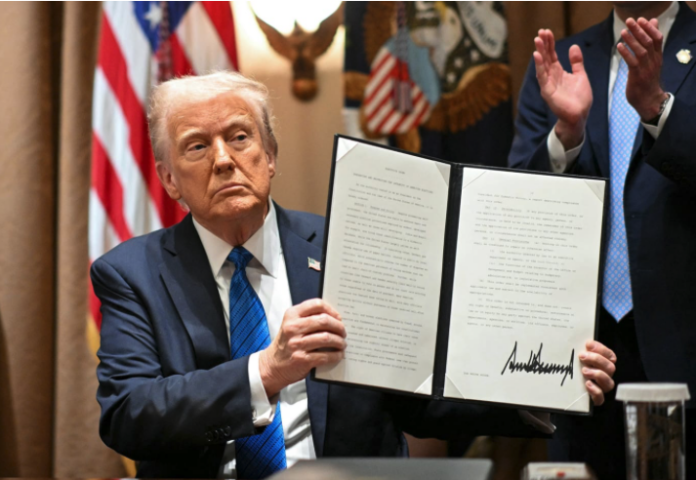
Well, it finally happened—President Donald Trump just signed what might be the most common-sense executive order Washington has seen in years, and naturally, the political left is treating it like the sky is falling. On Tuesday, Trump inked an executive order requiring proof of U.S. citizenship when registering to vote and mandating that ballots be reviewed by Election Day. Cue the outrage from the usual suspects.
Let’s break it down. The executive order directs that government-issued documentation, like a U.S. passport, REAL ID, or military identification, must be provided to register to vote in federal elections. It also tasks the Attorney General with setting up information-sharing agreements with state election officials to root out election fraud and violations of election law. Oh, and here’s the kicker: federal funding for election-related activities is now tied to whether states actually follow these federal integrity measures. Imagine that—using taxpayer dollars responsibly and with strings attached to ensure free and fair elections. Revolutionary.
Trump didn’t hold back in describing the move as a “great honor.” And for once, he may be understating it. In his words, “We think we’ll be able to end up getting fair elections.” Seems like a pretty reasonable goal—unless, of course, you benefit from chaos, confusion, and a few conveniently timed ballots trickling in days after the polls close.
Predictably, the criticism came fast and loud. The Brennan Center for Justice declared that the order would “block tens of millions of American citizens from voting.” Interesting math, considering the order targets non-citizens registering to vote and enforces deadlines that were standard practice not long ago. But when your entire playbook depends on playing fast and loose with election laws, anything resembling order and transparency probably feels like voter suppression.
Let’s not pretend this is coming out of left field. Republicans have been backing the SAVE Act, a bill that would essentially do the same thing legislatively: require documented proof of citizenship to register and prevent ballots from being counted after Election Day.
Naturally, Democrats have painted it as some apocalyptic return to Jim Crow. But let’s be clear—showing ID to vote is not voter suppression; it’s voter protection. You need an ID to board a plane, buy Sudafed, or rent a car. But when it comes to electing the leader of the free world, the left thinks it’s outrageous to ask for anything more than a name and a promise.
The executive order states plainly what millions of Americans already know: “Free, fair, and honest elections unmarred by fraud, errors, or suspicion are fundamental to maintaining our constitutional Republic.” And yet, the pushback is coming from people who insist that asking for any verification is somehow discriminatory.
The same folks who insisted that 2020 was the “most secure election in history” are now terrified that voters might be asked to prove they’re citizens before casting a ballot. Makes you wonder why.
Also included in the order is a provision to stop states from counting mail-in ballots received after Election Day—another move that was once considered standard procedure but is now treated as controversial. Why? Because setting clear deadlines threatens the conveniently drawn-out counting processes that lead to all kinds of speculation, lawsuits, and midnight vote dumps.
Trump just signed a sweeping election integrity bill:
-Requires proof of US citizenship on voter registration forms
-Cut funding to states that do not secure elections
-Vigorously prosecute election crimes
-Take action against states who count ballots received after Election Day… pic.twitter.com/NEGMbocKcc— Libs of TikTok (@libsoftiktok) March 25, 2025
In short, Trump’s executive order is about restoring confidence in a system that’s been increasingly viewed with skepticism by both parties. Whether Democrats want to admit it or not, a huge portion of the American electorate no longer trusts that elections are conducted cleanly—and that’s a dangerous place to be. This order doesn’t disenfranchise voters; it enfranchises citizens by ensuring their votes aren’t diluted by fraud or bureaucracy.
And if the loudest critics are the ones who benefit from the murkiest rules, maybe that’s all the proof we need that this executive order is long overdue.