
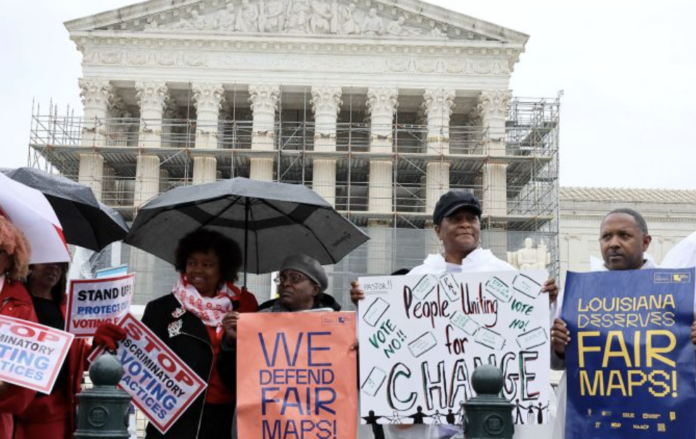
A new Supreme Court decision on congressional redistricting is sending a jolt through Democratic leaders in California, who now find themselves reassessing how far states can go when drawing political maps with race in mind.
On Wednesday, the Court struck down Louisiana’s latest congressional map, ruling that the state had gone too far by adding a second majority-Black district. The justices concluded that race had been used in a way that crossed constitutional lines. The decision is likely to make it more difficult for states to justify district boundaries primarily on claims of protecting minority voting power.
In California, the response from top Democrats was immediate and pointed. Governor Gavin Newsom framed the ruling as part of a broader pattern, arguing that the Court has been steadily weakening the Voting Rights Act. Writing on X, he said the decision undermines protections meant to ensure fair representation, particularly for minority communities.
Newsom has been one of the most visible figures pushing back against Republican-led redistricting efforts in states like Texas. His stance has included support for more aggressive map-drawing strategies in California, aimed at countering what Democrats see as partisan advantages elsewhere. That context helps explain why this ruling is landing with such urgency among state leaders.
Attorney General Rob Bonta, who has been involved in defending California’s own redistricting practices, called the decision “deeply disappointing.” He pointed to the long history of the Voting Rights Act, especially Section 2, which was designed to prevent racial discrimination in voting. Bonta also warned that past rulings weakening the law have often been followed by new restrictions at the state level, particularly affecting voters of color.
Former House Speaker Nancy Pelosi used even stronger language, describing the decision as a “devastating blow.” She argued that the effects will ripple beyond Louisiana, potentially leading to fewer communities having a meaningful voice in elections.
Pelosi also renewed calls for Congress to pass the John R. Lewis Voting Rights Advancement Act, which would restore federal oversight of certain state-level voting changes.
That proposed legislation would require states with recent records of voter discrimination to get federal approval before altering their election laws. Supporters see it as a way to rebuild safeguards that have been eroded by court decisions over the past decade.
Republicans in California, however, are viewing the ruling very differently. State Assemblymember David Tangipa, who has challenged Newsom’s redistricting approach in court, welcomed the decision as a step toward what he described as fairer, race-neutral maps. He argued that districts should represent all voters equally, without relying heavily on racial considerations.
The ruling doesn’t settle the broader debate, but it does shift the legal landscape. For now, both parties appear to be preparing for the next round of fights over how electoral maps are drawn—and what role race should play in shaping them.