
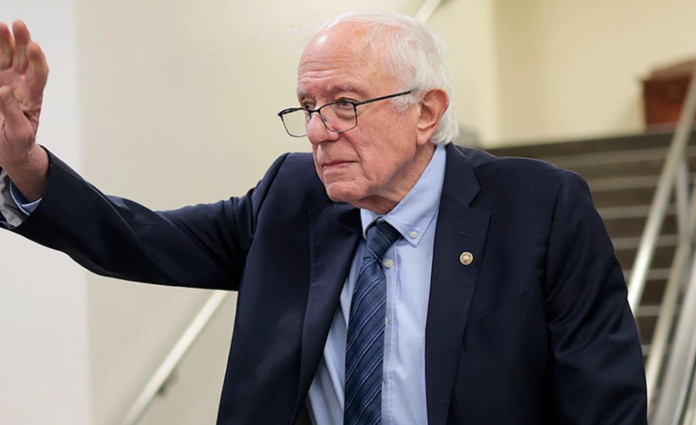
Rep. Rick Crawford is taking aim at Sen. Bernie Sanders ahead of a Capitol Hill event focused on artificial intelligence, accusing the Vermont independent of putting U.S. interests at risk by engaging with experts tied to China.
Crawford, who chairs the House Intelligence Committee, didn’t mince words in a recent appearance on Fox Business. He described Sanders as a “threat to national security,” pointing to the senator’s long history of criticizing U.S. economic and foreign policy, as well as past interactions with communist countries.
Crawford brought up Sanders’ 1980s trip to the Soviet Union, which took place while Sanders was serving as mayor of Burlington, Vermont. The visit was part of an effort to establish a sister-city relationship with Yaroslavl, though critics have continued to frame it as evidence of ideological sympathy.
Crawford also argued that Sanders’ current stance on artificial intelligence could weaken the United States at a critical moment. Sanders has been vocal about slowing the pace of AI development, warning that the technology is advancing faster than regulators can keep up. He has even floated the idea of pausing the expansion of AI infrastructure, including data centers, until lawmakers have a clearer framework in place.
The United States is home to the most talented AI researchers in the world.
Instead of harnessing American innovation, Senator Sanders is inviting foreign nationals to tell the United States how to regulate AI.
It would be like channeling Hugo Chavez to get advice on how to run… https://t.co/D4bnIeJz76
— Treasury Secretary Scott Bessent (@SecScottBessent) April 27, 2026
That approach has drawn pushback from Republicans and some officials in the Trump administration orbit, who see rapid AI development as a key part of maintaining a competitive edge over China. Treasury Secretary Scott Bessent echoed that concern, criticizing Sanders for inviting Chinese academics to participate in discussions about how AI should be governed. He argued that involving experts linked to Chinese institutions risks giving a strategic advantage to a geopolitical rival.
The panel Sanders is hosting includes Xue Lan of Tsinghua University and Zeng Yi of the Beijing Institute of AI Safety and Governance. Both are affiliated with organizations that have ties to Chinese government-backed initiatives on artificial intelligence policy.
Critics say their participation raises questions about influence and intent, particularly given the broader competition between the U.S. and China over emerging technologies.
Sanders, for his part, has framed the event differently. He has warned that unchecked AI development could pose serious risks, not just to national economies but to global stability. In his view, the stakes are high enough to warrant international cooperation, even among rival nations. He has described AI as a potential “existential threat” and argues that bringing together leading researchers from different countries is a necessary step toward setting global standards.