
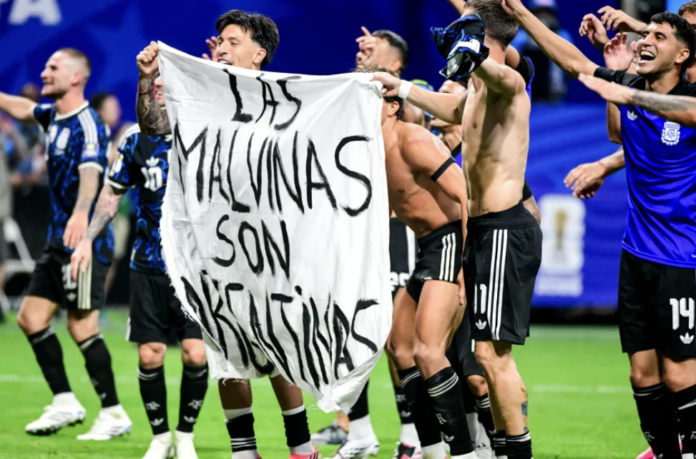
Argentina’s dramatic World Cup semifinal victory over England should have been remembered for its late goals and thrilling finish. Instead, the celebration that followed has created a controversy that could lead to disciplinary action from FIFA.
Argentina came from behind Wednesday to defeat England 2-1 and secure a place in Sunday’s World Cup final. The winning goal arrived in stoppage time, completing a memorable comeback and sending the Argentine players and supporters into celebration.
But after the match, several players were seen holding a banner that read, “Las Malvinas son Argentinas,” meaning “The Falkland Islands are Argentinian.”
The message referred to the long-running dispute between Argentina and the United Kingdom over the Falkland Islands, known in Argentina as Las Malvinas. Because FIFA rules prohibit political messages on equipment and clothing, the display may have consequences for the players involved or for the Argentine team.
The International Football Association Board’s rules state that equipment must not contain political, religious or personal slogans, statements or images. Players are also prohibited from revealing clothing that carries those types of messages.
The rules further explain that violations may result in sanctions from the competition organizer, a national soccer association or FIFA.
The banner was not an accidental or casual reference. Argentina has claimed sovereignty over the Falkland Islands for generations, while the United Kingdom maintains control of the territory. The islands are located roughly 300 miles from Argentina’s coast, and the dispute remains a powerful issue in Argentine politics and national identity.
LIONEL MESSI TO LAUTARO MARTINEZ TO GIVE ARGENTINA THE LEAD IN STOPPAGE TIME 🇦🇷
IT’S ABSOLUTELY REMARKABLE 😱
England is now +800 to qualify.pic.twitter.com/SPvuTx6RNS
— FanDuel Sportsbook (@FDSportsbook) July 15, 2026
The Falkland Islands government says the territory had no native population before European settlement and argues that no indigenous residents were displaced. Britain established a presence on the islands during the 18th century and regained control in 1833 after removing an Argentine garrison.
The dispute escalated into war in 1982, when Argentine forces invaded the islands. Britain responded by sending a military task force to retake them. The conflict lasted more than two months and resulted in the deaths of nearly 1,000 Argentine and British service members, along with civilian Falkland Islanders.
The war continues to hold deep emotional significance in both countries. In Buenos Aires, the Falklands War Memorial stands across from the Torre Monumental, a clock tower built with funding from the city’s British community. The placement is widely viewed as a reminder of the unresolved territorial dispute.
British officials quickly criticized the players’ celebration.
GOOOOAAL! ENZO FERNÁNDEZ DRAWS ARGENTINA LEVEL WITH ENGLAND IN THE SEMIFINALS 🇦🇷 pic.twitter.com/A84NfiCmWH
— FOX Sports (@FOXSports) July 15, 2026
A representative for outgoing Prime Minister Keir Starmer said that although England had lost the match, British sovereignty over the Falkland Islands remained unchanged. The representative also repeated the British government’s position that the islanders have the right to determine their own political future and said Starmer supported a FIFA investigation.
U.K. Business Secretary Peter Kyle also described the display as inappropriate.
FIFA said its independent Disciplinary Committee was reviewing the match reports and considering whether further action should be taken under its disciplinary code. Penalties for political displays can include fines, which may reach approximately $20,000 depending on the circumstances.
The controversy overshadowed what had been an extraordinary finish to the semifinal.
England carried a 1-0 lead into the final minutes, but Argentina equalized in the 85th minute when Lionel Messi created an opportunity for midfielder Enzo Fernández. Fernández converted the chance to bring Argentina level.
Messi played another decisive role in stoppage time, delivering the cross that Lautaro Martínez headed into the net for the winning goal. Argentina will now face Spain in Sunday’s World Cup final.